
Wood vs. White Kitchen Cabinets in 2026: What the Data Actually Shows

by Andrew Saladino
April 19, 2026
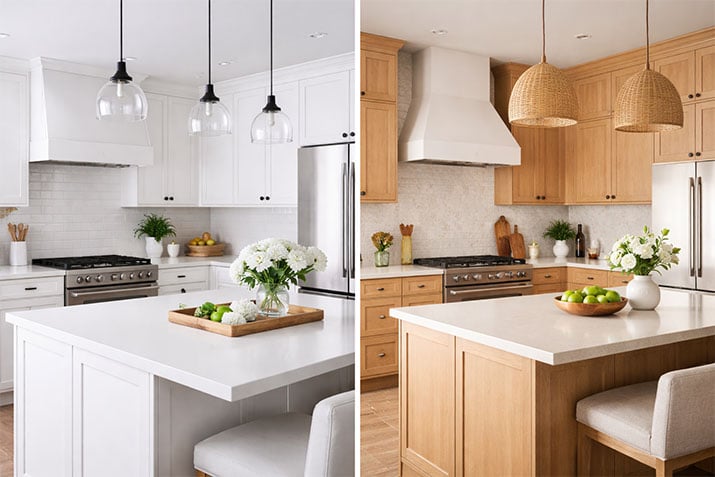
For the first time in nearly a decade, wood cabinets are the most popular choice in American kitchen renovations. According to the 2026 Houzz Kitchen Trends Study, which surveyed 1,780 homeowners, 29% chose wood cabinets for their most recent remodel. White came in at 28%. One point separated them, but the direction is clear, and it is backed by three independent data sources all pointing the same way.
So what does that actually mean for your kitchen? And does it mean white is on its way out? Not quite. Here is what the full picture shows.
White Kitchen Cabinets Are Not Going Out of Style
White cabinets are not disappearing. They are still chosen by more than one in four homeowners remodeling their kitchen in 2026, and 96% of design professionals surveyed by the NKBA still recommend neutral palettes as the foundation for kitchen design.
What has changed is which version of white is winning. The stark, cool, clinical white that dominated kitchens from roughly 2010 to 2022 is losing ground. Warm off-whites, cream, linen, and oatmeal tones are taking its place. These colors still reflect light beautifully and appeal to the widest range of buyers, but they feel livable rather than sterile. If you are choosing white kitchen cabinets today and want them to hold their appeal for the next 5 to 10 years, the warm version of white is the safer long-term investment.
What Is Replacing Stark White?
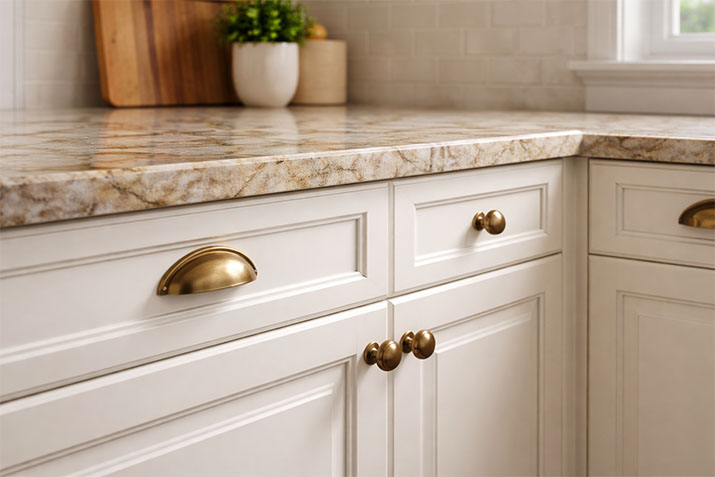
Warm putty, mushroom, cream, and oatmeal finishes are filling the space that cool bright white used to occupy. These tones pair naturally with wood accents, brushed brass hardware, and natural stone countertops, all of which are trending strongly in 2026. The result is a kitchen that feels curated and warm rather than like a showroom floor.
What the 2026 Data Actually Shows About Wood vs. White
The Houzz finding is one data point. What makes the wood trend significant is that three completely independent sources, with different methodologies, different survey populations, and different publication dates, all arrived at the same conclusion in the same year.
The 2026 Houzz Kitchen Trends Study (1,780 homeowners, January 2026) found wood at 29%, up six points year-over-year, with white falling to 28% after a five-point drop. The NKBA 2026 Kitchen Trends Report (634 industry professionals, September 2025) found that 59% of design professionals identified wood grain as a growing trend, with white oak emerging as the preferred species at 51% of professional specifications. And MasterBrand’s annual report, published in 2025, found that for the first time in nine consecutive years, white was not the top preferred cabinet finish. Light wood stains took the top position.
Three different sources. Three different groups of people. All pointing the same direction at the same time. That is what moves something from a trend piece headline to a genuine market shift.
Medium Wood Tones Are Leading the Way
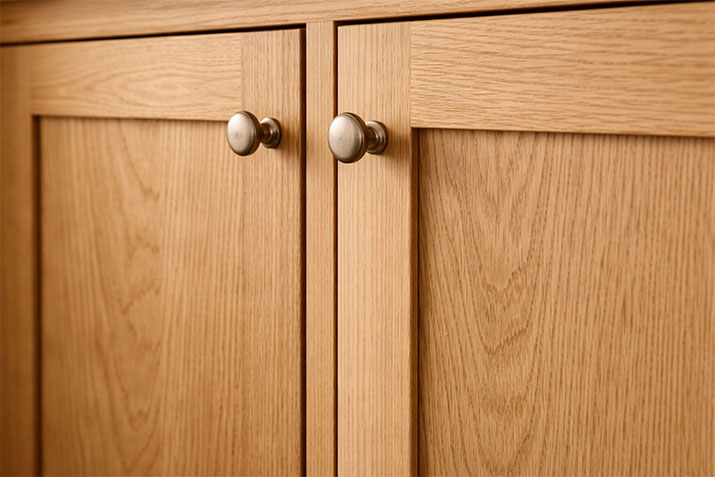
Of the 29% who chose wood in 2026, medium tones led at 15%, light wood at 11%, and dark wood at just 3%. This is not the honey oak of the 1990s. Today’s wood cabinets feature cooler, cleaner stains, flatter door profiles, and significantly less orange in the finish. White oak in particular has gray undertones that photograph beautifully and pair well with nearly any countertop material. If you want to go deeper on which species might work for your kitchen, our guide to types of wood cabinets breaks down the key differences.
Which Is Better for Resale Value, Wood or White?
The honest answer: the question is not really wood versus white. It is warm versus cool.
Both wood and warm-toned whites perform well for resale. Both appeal to a broad buyer pool. What has lost resale appeal is the all-white, stark, monochromatic kitchen that dominated the 2010s. If you are choosing between a warm white oak and a warm cream painted cabinet, either will serve you well at resale. If you are comparing either of those against a cool, bright white kitchen, the data now suggests the warm option has stronger broad appeal.
For homeowners thinking about ROI more broadly, it is worth knowing that a minor kitchen remodel returns 113% nationally on average, according to the 2025 Zonda Cost vs. Value Report. That figure does not depend on whether you choose wood or white. It depends on keeping the scope focused and the finishes timeless. You can read the full breakdown of kitchen remodel ROI, including data by region and remodel scope, in our 2026 Kitchen ROI and Cabinet Trends Report.
The Warm Versus Cool Distinction
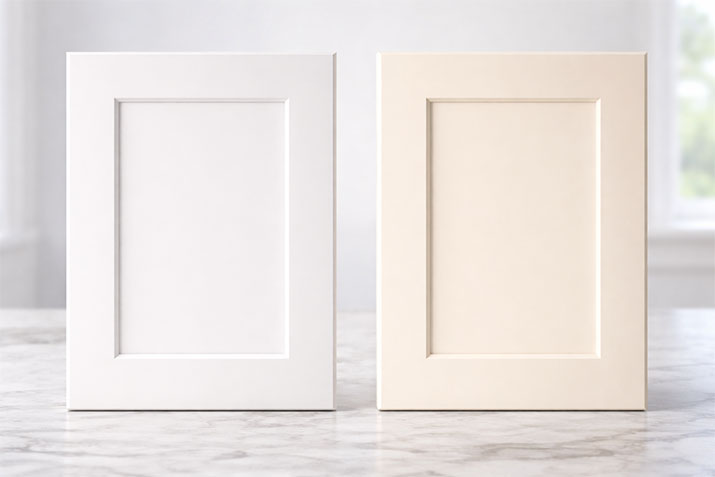
If your current kitchen has stark, cool-toned white cabinets, the update most likely to improve buyer appeal is not replacing them with wood. It is replacing them with a warm white. That is a smaller project with a meaningful visual impact. If you are starting from scratch, both warm white and white oak give you strong resale flexibility.
Do Wood Cabinets Go Out of Style?
Wood is a material, not a finish color. That distinction matters more than it might seem.
Trend finishes expire. Think of avocado green in the 1970s, glossy high-contrast black and white in the early 2000s, or the gray subway tile that peaked around 2017. These were colors and finishes tied to a specific cultural moment. Wood cycles. It fell out of fashion when painted kitchens took over in the 2010s, not because wood was bad but because of how it was being applied.
The honey oak of the 1990s went out of style because of the orange-toned stains, the ornate raised panel doors, and the matching oak flooring that came with it. The material itself was never the problem. Today’s wood cabinets are a completely different application. White oak with rift-sawn grain. Flat or slim shaker profiles. Matte or satin finishes. These read as modern, not dated. And because wood can be refinished rather than replaced, a quality solid wood cabinet also gives you options that painted MDF simply cannot.
What Makes Today’s Wood Different from the 1990s
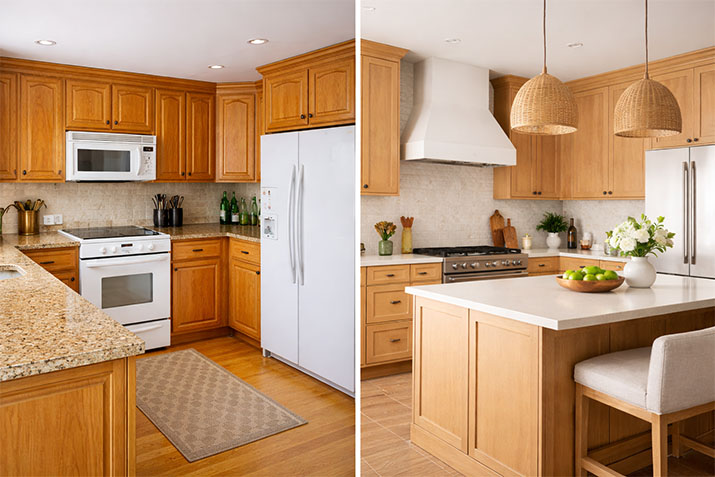
Cooler stains instead of orange tones. Flat or minimalist door profiles instead of ornate raised panels. Matte finishes instead of high gloss. Paired with natural stone and warm hardware instead of matching oak floors and dated fixtures. Same material, completely different result.
What Wood Species Is Best for Kitchen Cabinets in 2026?
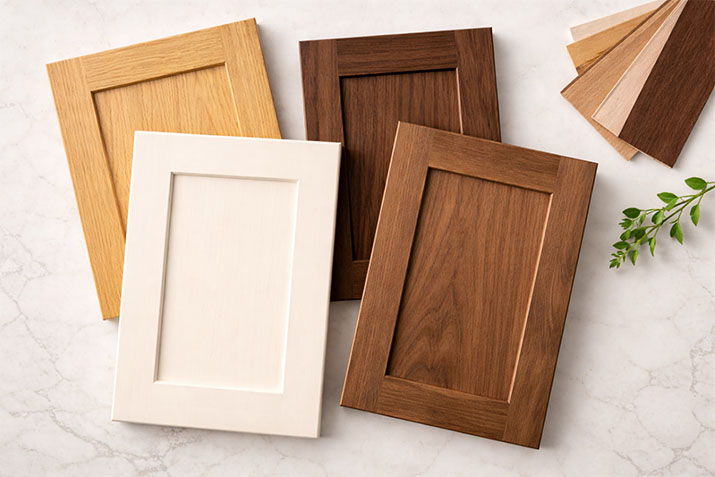
White oak leads by a significant margin. According to the NKBA 2026 Kitchen Trends Report, 51% of design professionals specify white oak as their preferred species. Its appeal comes down to a few practical qualities: gray undertones rather than red or orange, tight and consistent grain, and the ability to work in both modern and transitional kitchens without looking out of place in either.
Maple is the most common budget-friendly alternative. It has a similar clean aesthetic, takes stain evenly, and is widely available. Walnut is the choice for higher-end or more dramatic interiors, with its deep color and natural variation creating instant character without needing much else to compete with it in the design. Our full guide to types of wood cabinets covers species, grain patterns, durability, and what to expect from each option across different price points.
Can You Mix Wood and White Cabinets in the Same Kitchen?
Yes, and about 24% of renovating homeowners are already doing exactly that.
The two-tone kitchen, with different colors or finishes on upper and lower cabinets, has moved from a design trend into a mainstream approach. In these kitchens, white dominates upper cabinets in 40% of cases, while wood leads lower cabinets at 37%. The practical logic behind this combination is sound: upper cabinets read against the wall and benefit from lightness, lower cabinets anchor the room and benefit from warmth and depth.
If you genuinely like both finishes and do not want to commit fully to one, the two-tone approach is not a compromise. It is increasingly the recommended choice among designers because it gives you broad buyer appeal while creating a kitchen that feels layered and considered rather than generic.
The Most Popular Two-Tone Combination in 2026
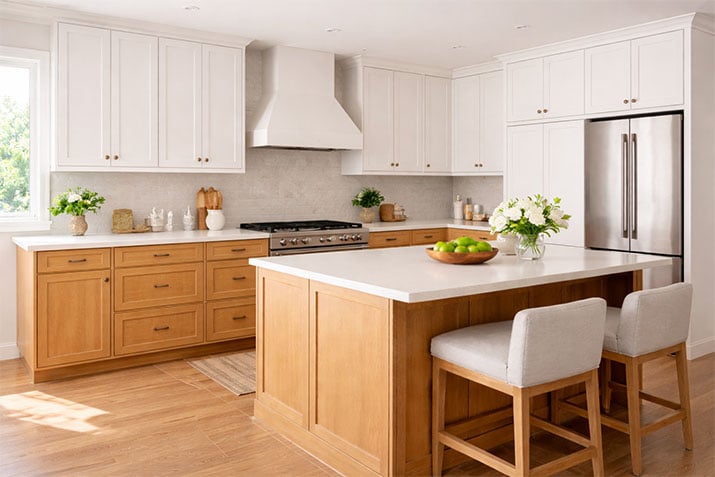
White or warm off-white uppers with white oak lowers. The island, when present, often gets a different countertop material too. Butcher block or wood slab is the choice for 44% of homeowners who differentiate their island from the perimeter. The result is a kitchen that uses both finishes intentionally rather than defaulting to one.
Do Wood Cabinets Hide Dirt and Wear Better Than White?
In a working kitchen, yes. Noticeably so.
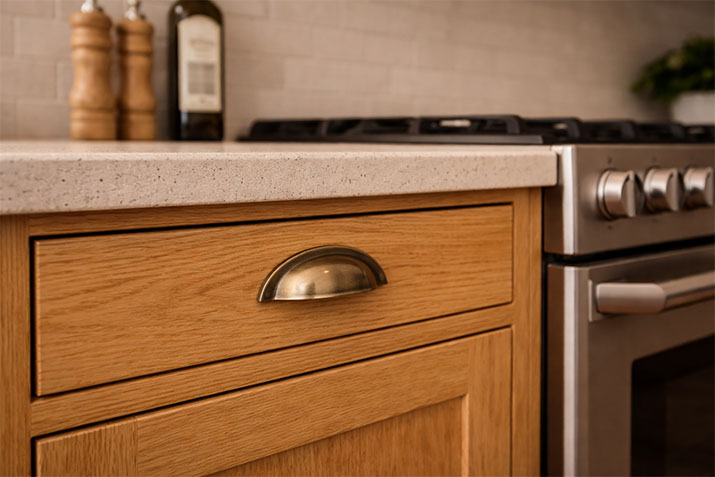
The natural grain in wood cabinets camouflages minor scuffs, fingerprints, and everyday wear in a way that painted white surfaces cannot. The areas that tend to show the most in white kitchens, around the range, near pulls, and at the corners of lower doors, are exactly where wood’s forgiving surface does its best work.
White cabinets are not impossible to maintain, but they do require more frequent attention. Grease near the range, fingerprints around handles, and general smudging from daily use are all more visible on a painted white surface than on a wood finish with natural grain variation. Wood does have its own requirements. The finish should be sealed and maintained, and solid wood can be affected by significant changes in humidity. But day-to-day visibility of wear is meaningfully lower, which makes it a practical advantage for households with children, heavy cooking, or high traffic.
The Best Way to Make This Decision
Most homeowners who spend weeks deliberating between wood and white end up wishing they had ordered samples first.
Seeing both finishes in your own kitchen, under your own lighting, next to your counters and floors, tells you more in five minutes than any article can. Colors and finishes read completely differently under warm incandescent light versus cool natural light, and your kitchen’s specific exposure makes a bigger difference than you might expect.
Order free cabinet door samples from Kitchen Cabinet Kings and see how each finish actually looks in your space before committing to anything. If you want a professional eye on the decision, our free 3D kitchen design service can show you both options in your actual layout with your measurements.
Frequently Asked Questions
Are wood or white cabinets better for resale value in 2026?
Both perform well for resale when the finish is warm and tasteful. The 2026 Houzz data shows wood at 29% and white at 28%, essentially tied for the first time in nearly a decade. The more useful distinction for resale is warm versus cool. Warm off-whites and wood tones both outperform stark, clinical white for broad buyer appeal. If you are choosing for resale, either a warm white or white oak is a sound choice.
Are white kitchen cabinets going out of style?
No, but the all-white kitchen is fading. White remains chosen by more than one in four homeowners remodeling in 2026. What is declining is the stark, cool, monochromatic all-white look. Warm whites, creams, and off-whites are growing at the expense of the clinical bright white specifically. White is not out. The version of white that looked like a laboratory is.
What is the most popular kitchen cabinet color in 2026?
Wood finishes are now the most popular choice at 29% of renovating homeowners, edging out white at 28% for the first time since 2016, according to the 2026 Houzz Kitchen Trends Study. Medium wood tones lead at 15%, followed by light wood at 11%.
Do wood cabinets go out of style?
Wood as a material does not go out of style. The way it gets applied can. The honey oak of the 1990s felt dated because of how it was used: orange-toned stains, ornate raised panels, matching oak floors. Today’s wood cabinets use cooler stains, flat or slim shaker profiles, and matte finishes. The material is the same. The result reads as completely modern.
What wood species is most popular for kitchen cabinets in 2026?
White oak leads professional specifications at 51%, according to the NKBA 2026 Kitchen Trends Report. Its appeal comes from gray undertones rather than the orange or red warmth of other species, a tight consistent grain, and versatility across both modern and transitional kitchen styles. Maple is the most popular budget alternative. Walnut is the choice for higher-end or more dramatic kitchens.
Is white oak a good choice for kitchen cabinets?
Yes. White oak is the most specified wood species among design professionals in 2026. It has cool gray undertones that read as modern, it ages without darkening significantly, and it pairs well with a wide range of countertop materials and hardware finishes. It is also a material that can be refinished rather than replaced if you want to update the look years down the road.
Can you mix wood and white cabinets in the same kitchen?
Absolutely, and 24% of renovating homeowners are already doing it. The most common combination is white or off-white upper cabinets with wood lowers. In two-tone kitchens, white leads uppers at 40% and wood leads lowers at 37%, according to Houzz. This approach gives you the brightness of white where the room needs it and the warmth of wood where it grounds the space.
Are wood cabinets more expensive than white cabinets?
Solid wood cabinets generally cost more upfront than painted MDF or thermofoil options. The gap narrows significantly with semi-custom and RTA options. White oak and maple are more accessible price points within the wood category. Walnut sits at the higher end. The long-term case for wood includes refinishing potential and durability that painted surfaces cannot always match, which changes the cost calculation over the life of the kitchen.
Do wood cabinets hide dirt and wear better than white?
Yes, in everyday use. Natural wood grain conceals minor scuffs, fingerprints, and general wear more effectively than painted white surfaces. High-traffic areas like around pulls and near the range show wear much faster on white painted cabinets than on a stained wood finish. For households with children or heavy daily cooking, this is a practical advantage worth factoring in.
Not sure which finish is right for your kitchen? Order a free door sample and see it in your own space before you decide.

Andrew Saladino
Andrew Saladino co-founded Kitchen Cabinet Kings in 2010, and the company has since delivered cabinets for more than 110,000 kitchens. Named to the NKBA 30 Under 30 in 2013 and 2014, he writes about cabinet styles, construction, finishes, costs, lead times, and the ordering details that are easy to miss until the cabinets arrive.