

Cabinet Glossary
What is Kerf?
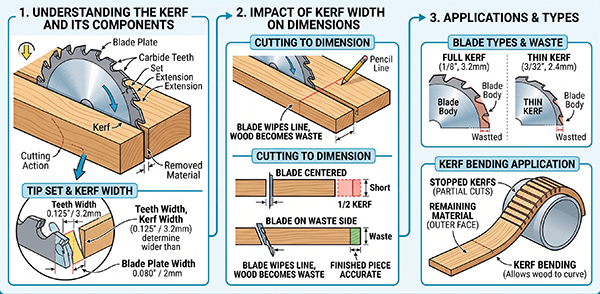
A kerf is the slot a saw blade leaves in the material it cuts. The term also refers to the width of that cut, which is usually wider than the blade’s body because the teeth extend beyond its sides.
The blade removes this material, so its width affects the finished piece’s dimensions. Centering the blade on a pencil line leaves the piece short by half the kerf. Cabinetmakers account for this by marking the waste side of the line and cutting on that side.
A typical full-kerf table saw blade cuts a slot about 1/8 inch wide. Thin-kerf blades often cut closer to 3/32 inch, wasting less material and requiring less motor power, though they can flex more during a cut.
A kerf can also stop partway through a board. A series of closely spaced cuts on the inside face of a bend lets the wood curve, a technique called kerf bending. Cabinetmakers use it for curved cabinet ends and radius trim.