
Particle Board vs. Plywood Cabinets: Is One Better Than the Other?
By: Andrew Saladino |  7 min
7 min
Last Updated: August 16th, 2024
Kitchens and bathrooms are the workhorses of your home, and your cabinets need to be able to handle everything from sticky fingers to heavy cast iron pans. But when choosing between particle board vs. plywood cabinets, you’ll need to weigh your remodeling budget and lifestyle needs to decide which is right for you.
This article will delve into the key differences between particle board and plywood cabinets, helping you navigate this important decision for your home.
Particle Board vs. Plywood Cabinets
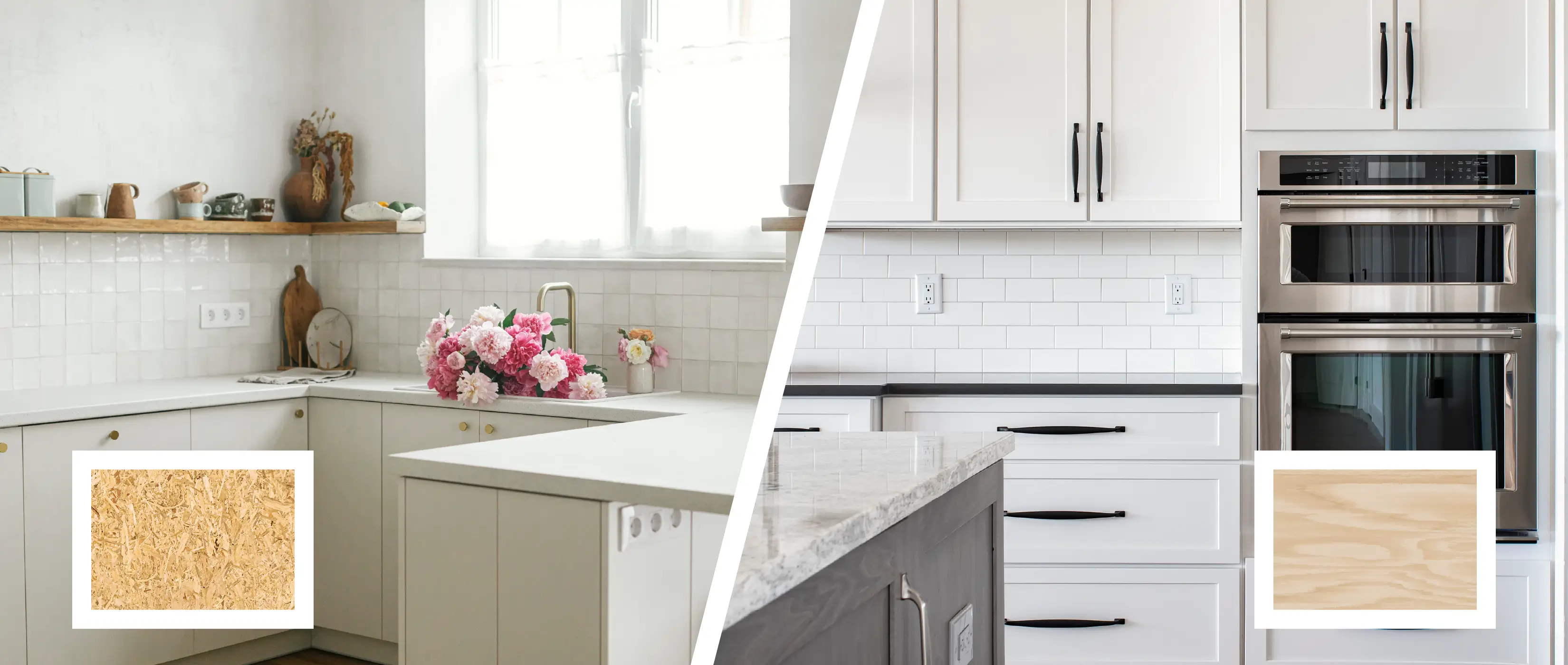
Particle board and plywood cabinets are both budget-conscious options, but they each have their own pros and cons.
Particle board, made from compressed wood chips, is generally less expensive and offers a smooth, even surface ideal for painting. However, it can be susceptible to moisture damage and may not hold screws as well as plywood over time.
Plywood, on the other hand, is constructed from layers of thin wood veneers glued together in a crisscross pattern. This creates a much stronger, more water-resistant cabinet that can handle heavier loads and more frequent use.
The downside? Plywood cabinets typically come with a higher price tag and may show a more natural wood grain through paint or veneer.

| Particle Board | Plywood | |
|---|---|---|
| Composition | Compressed wood chips with resin | Layers of thin wood veneer glued in a crisscross pattern |
| Appearance | Smooth, even surface | Visible wood grain (may show through paint/veneer) |
| Durability | Less water-resistant, susceptible to damage | More water-resistant, very strong |
| Workability | Easy to cut and drill, poor screw-holding over time | More difficult to cut/drill (requires stronger tools), excellent screw-holding |
| Lifespan | 3-15 years | 20-30 years |
| Price | More affordable | More expensive |
| Sustainability | Recyclable depending on the resin type | More sustainable, often uses faster-growing wood species |
Particle Board Cabinets

Particle board cabinets are a cost-effective choice for kitchens and bathrooms. Manufacturers construct them by compressing leftover wood scraps, sawdust, and resin into flat panels to create a smooth, even surface ideal for painting or laminating.
While particle board cabinets cost roughly 30%-50% less than plywood cabinets, you’ll trade durability for affordability. They may not hold up well to daily wear and tear, and you’ll need to replace your cabinets sooner compared to plywood cabinets.
Pros and Cons of Particle Board Cabinets
Particle board cabinets offer an attractive price point, but are they the right choice for your home? Here's a breakdown of their pros and cons to help you decide:
Pros:
- Affordable: Particle board is a significantly cheaper option than plywood and natural wood cabinets. This can be a major advantage for those on a tight budget.
- Lightweight: The lighter weight of particle board cabinets makes them easier to handle and install, especially for wall-mounted ones.
- Smooth surface: Particle board offers a smooth, even surface that's ideal for painting or laminating in various colors and styles.
- Versatile: They can be used in various areas of the home, including kitchens, bathrooms, laundry rooms, and even built-in furniture.
Cons:
- Low durability: Particle board is susceptible to moisture damage, which can cause swelling, warping, and loss of structural integrity. This is especially problematic in areas like kitchens and bathrooms.
- Poor screw-holding: Screws may not hold as well in particle board over time, leading to loose hinges and potentially requiring earlier cabinet replacement.
- Shorter lifespan: Compared to plywood or solid wood, particle board cabinets typically have a shorter lifespan — typically just 3-15 years — especially with heavy use or exposure to moisture.
- Lower resale value: Homes with particle board cabinets may fetch a slightly lower price than those with more durable cabinet materials.
- Environmental impact: While some particle board is made with recycled wood content, the resin used in the manufacturing process can raise sustainability concerns.
Pros
- Affordable
- Lightweight
- Smooth surface
- Versatile
Cons
- Low durability
- Poor screw-holding
- Shorter lifespan
- Lower resale value
- Environmental impact
Plywood Cabinets

Constructed by meticulously gluing thin layers of real wood veneer in a crisscross pattern, plywood boasts exceptional strength and resistance to warping, moisture, and everyday wear and tear. Plywood cabinets can last for decades, making them a smart investment for homeowners who prioritize quality and longevity.
While the upfront cost is higher than that of particle board, plywood cabinets have a significantly longer lifespan that could save you money in the long run. They’re ideal for homeowners who value a long-lasting kitchen or bathroom and are willing to invest in a higher-quality product.
Pros and Cons of Plywood Cabinets
Plywood cabinets shine with their exceptional durability, but there are other things to consider when choosing between plywood vs. particle board.
Pros:
- Durable: Plywood cabinets last for decades with proper care, making them a great long-term investment.
- Moisture resistant: Their construction makes them ideal for withstanding humidity in kitchens and bathrooms.
- Strong and stable: The crisscross layering provides exceptional strength and a stable core that holds screws well, perfect for heavy-duty use and frequent opening and closing.
Cons:
- More expensive: Plywood cabinets typically cost 30%-50% more than particle board options, but they are cheaper than most solid wood options.
- Temperature-sensitive: While moisture-resistant, plywood may not be the best choice for areas prone to significant temperature fluctuations that can cause warping. Solid wood might be a better option in such cases.
Pros
- Durable
- Moisture resistant
- Strong and stable
Cons
- More expensive
- Temperature sensitive
What To Consider When Choosing Between Particle Board vs. Plywood
Plywood and particle board cabinets offer distinct advantages, but navigating the ideal option isn’t always easy. This section delves into the key factors to consider when comparing particle board vs. solid wood, like budget, desired aesthetics, lifestyle needs, and durability.
Aesthetics
Aesthetics come down to personal preference, but there are some key differences between plywood and particle board cabinets. Particle board offers a smooth, uniform surface ideal for painting, making it a great choice for homeowners who want a clean, modern look and the freedom to customize with any paint color.
Plywood cabinet doors, on the other hand, highlight the natural wood grain through paint or veneer. This can add a touch of warmth and texture to your kitchen or bathroom.
Pro Tip: Still want that uniform finish of particle board without sacrificing the durability of plywood? Opt for plywood cabinet boxes. All of our cabinet boxes are made with Grade A plywood, whether you opt for solid wood doors or painted MDF.
Durability
Durability is where particle board and plywood cabinets take widely different paths. Particle board prioritizes affordability over strength. Its compressed wood chips are susceptible to moisture damage, causing cabinets to swell, warp, and lose their structural integrity. This makes them a risky choice for moisture-prone areas like kitchens and bathrooms.
Plywood, on the other hand, is built to last — often as long as 30 years. The crisscrossed layers of wood veneer create a fortress-like resistance to warping, moisture, and everyday wear and tear.
Installation
The process of installing particle board and plywood cabinets can be similar on the surface, but there are a few key differences. Particle board's lighter weight makes it easier to maneuver, especially for wall-mounted cabinets. It also cuts and drills more easily with standard woodworking tools. However, particle board's structure can crumble if not handled carefully.
Plywood cabinets are slightly more challenging to install. Their denser construction requires sturdier tools for cutting and drilling. But plywood holds screws exceptionally well, ensuring they last decades. While both materials benefit from pre-drilled holes to prevent splitting, plywood's strong core makes it especially easy for a secure cabinet build.
Cost
Particle board reigns supreme in affordability. However, this lower upfront cost comes with the potential for needing replacements sooner due to lower durability.
Plywood cabinets, on the other hand, represent a significant investment. While they carry a heftier price tag, their extended lifespan can outweigh the initial cost. Over the years, you might end up spending less by investing more upfront.
Environmental Impact
The environmental impact of plywood and particle board cabinets is more complex. Particle board is often made with recycled wood scraps, which reduces reliance on harvesting new trees. However, some of the resins used to bind the particles contain formaldehyde, a volatile organic compound (VOC) that can contribute to indoor air quality issues and has environmental drawbacks during manufacturing.
Plywood, on the other hand, often uses faster-growing wood species, which can be a more sustainable forestry practice. Some plywood manufacturers also opt for low-VOC or formaldehyde-free glues, further reducing its environmental impact. However, plywood production still requires adhesives and energy for manufacturing.
Eager to get a jump-start on designing your dream kitchen? Reach out to our NKBA-certified designers for pro tips, price quotes, and a free 3D kitchen design.
Start Designing Your Dream KitchenParticle Board vs. Plywood FAQs
What is particle board best used for?
Particle board cabinets are ideal for budget-conscious homeowners who prioritize affordability and a smooth, paint-ready surface for kitchens, bathrooms, laundry rooms, or built-in furniture. However, you may need to replace them sooner due to their poor durability and moisture resistance.
Does particle board need primer?
Yes, particle board needs primer before painting. Primer can help:
- Seal the absorbent surface for even paint application
- Improve paint adhesion to prevent chipping
- Offer some extra moisture resistance, especially with oil-based primer
Can you fix rotted particle board?
Fixing rotted particle board depends on the severity of the damage. For minor rot (small, soft areas), you can try drying it thoroughly, sanding away damaged sections, and filling it with wood filler.
However, particle board's compressed nature makes repairs extra difficult. For extensive rot or areas where the board is crumbling, replacing the damaged section or entire board is usually recommended to maintain structural integrity and aesthetics.
Choosing between particle board vs. plywood cabinets ultimately comes down to your priorities. Plywood reigns supreme for durability and long-term value, especially in moisture-prone areas like kitchens and bathrooms.
However, particle board offers a budget-friendly option with a smooth, paint-ready surface, ideal for those prioritizing affordability and a modern look — just be aware it may not last as long.
Looking for high-quality kitchen cabinets that won’t break the bank? Browse our selection of RTA and assembled cabinets to find the perfect cabinet style you’ll enjoy for years to come.