
How to Measure Your Kitchen for Cabinets in 7 Steps
By: Andrew Saladino |  16 min Updated: March 2026
The best kitchen designs start with accurate kitchen measurements. Whether you are planning to DIY or working with a contractor on installing new kitchen cabinets, the success of your kitchen remodel hinges on a thorough floor plan. From recording the center point of big appliances to marking obstructions, there is a lot to account for before you can start designing your dream kitchen.
To help save you time and confusion, we created a step-by-step guide on how to measure for kitchen cabinets and plan your new layout. It walks through instructions from start to finish, with expert tips to help you along the way.
Keeping the same layout or designing a new one? Both workflows start the same way: you need accurate wall, ceiling, window, and appliance measurements before you can order anything. If you are keeping the footprint, you will also measure your existing cabinets for reference. If you are redesigning, you can focus on the empty wall dimensions instead. We cover both cases below.
Download the PDF below for printable instructions and a sample grid layout to get started on measuring your kitchen for new kitchen cabinets.
What You Will Need to Measure Your Kitchen
Before you start measuring, gather these tools. They are all inexpensive and available at any hardware store. A helper is optional but makes measuring large walls significantly easier.
25-Foot Tape Measure
A steel tape is best. Anything shorter may not reach across larger kitchens. A locking tape helps when measuring solo.
Graph Paper
Grid paper makes it easy to sketch walls to approximate scale. Our downloadable PDF includes a pre-formatted grid layout.
Pencil and Eraser
You will make changes as you measure. Do not use pen. Keep an eraser close so you can correct mistakes cleanly.
Level
A 2-foot level helps you spot uneven walls and floors before they become installation problems. Older homes often need shims.
Step Stool
You need it for ceiling measurements and upper wall sections. A small 2-step stool is enough for most kitchens.
Smartphone
Take photos of each wall alongside your written measurements. Photos serve as a visual backup if any dimension is unclear later.
Tools | 1. Draw Your Floor Plan | 2. Horizontal Measurements | 3. Vertical Measurements | 4. Mark Obstructions | 5. Place Appliances and Utilities | 6. Choose Your Kitchen Layout | 7. Shop for Kitchen Cabinets | Measure Cabinet Doors for Replacement | Common Mistakes to Avoid | FAQs
1. Draw Your Floor Plan
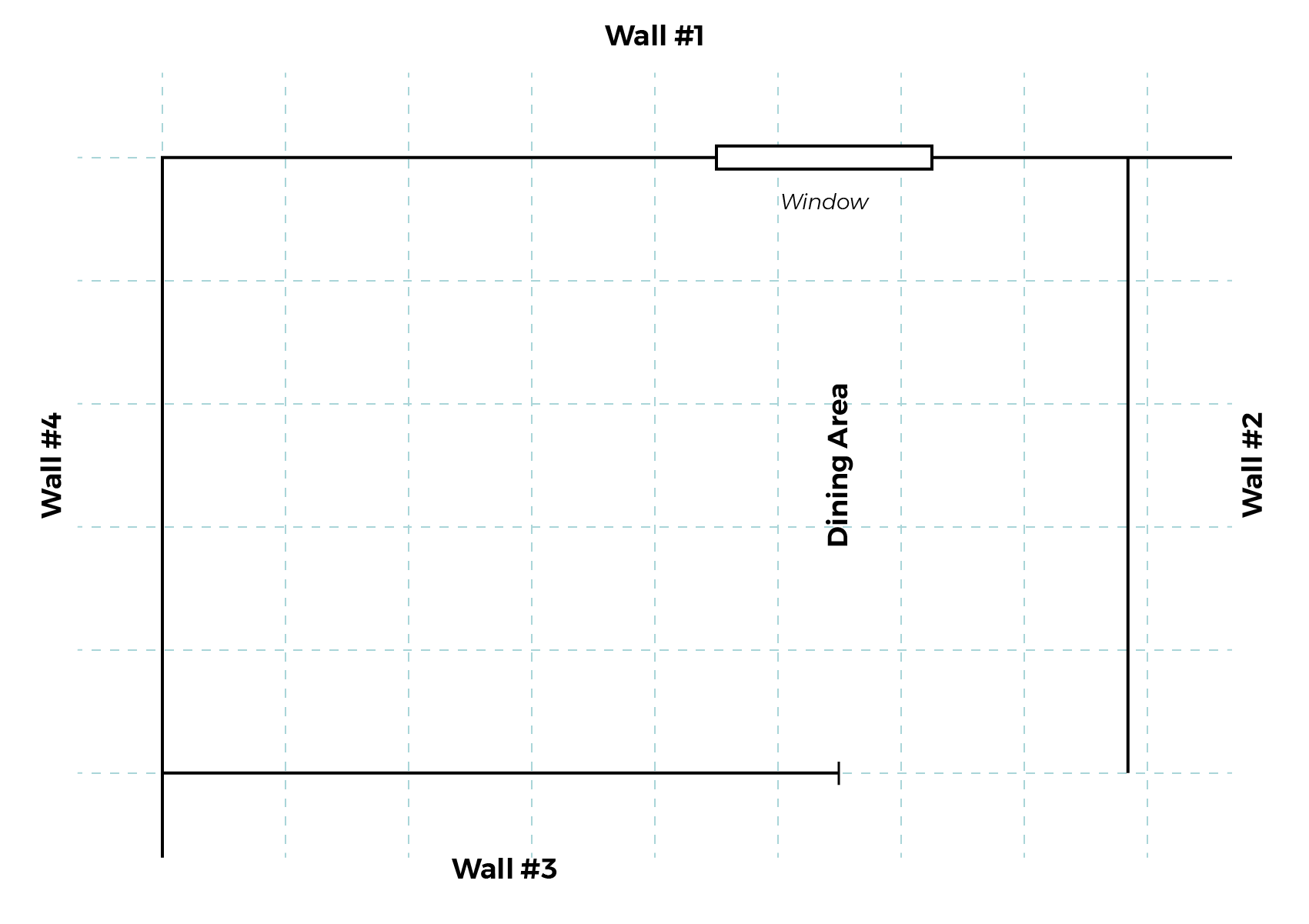
To carefully configure the dimensions of your kitchen, start with a floor plan. Sketch your kitchen layout using grid paper.
Be sure to mark the exact locations of any of the following:
- Doors
- Windows
- Electrical outlets
- Light switches
- Gas lines
- Water lines
- Drain lines
- Hood vents
- Heating and air vents
Use this key to label openings and obstructions on your kitchen floor plan.

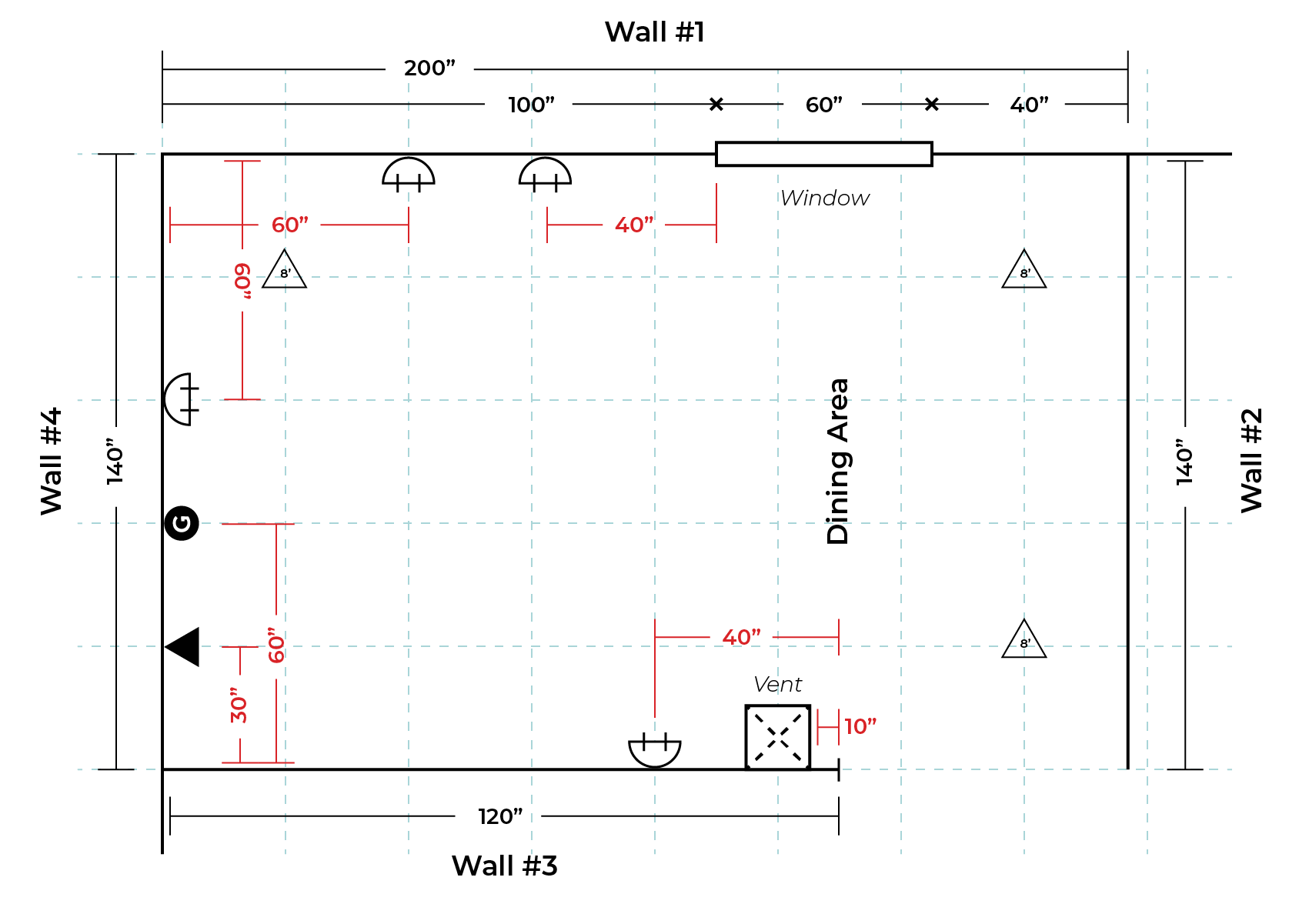
The first rough draft of your floor plan should look similar to the example below. While it does not need to be exactly to scale, your sketch should be neat, clear, and accurate.
Take photos of your kitchen so you can compare before and after pictures of your kitchen transformation.
2. Record Your Horizontal Measurements
Once you have the first draft of your floor plan, it is time to measure the length of your space. Accurate horizontal measurements are the foundation of your entire kitchen measuring guide and directly affect which cabinet widths will fit.
Always record your kitchen cabinet measurements in inches, never in feet and inches. Writing 42" is much clearer than 3' 6", and it matches how cabinet manufacturers size their products. Mixing units is one of the most common causes of ordering mistakes.
How to Measure Full Wall Lengths
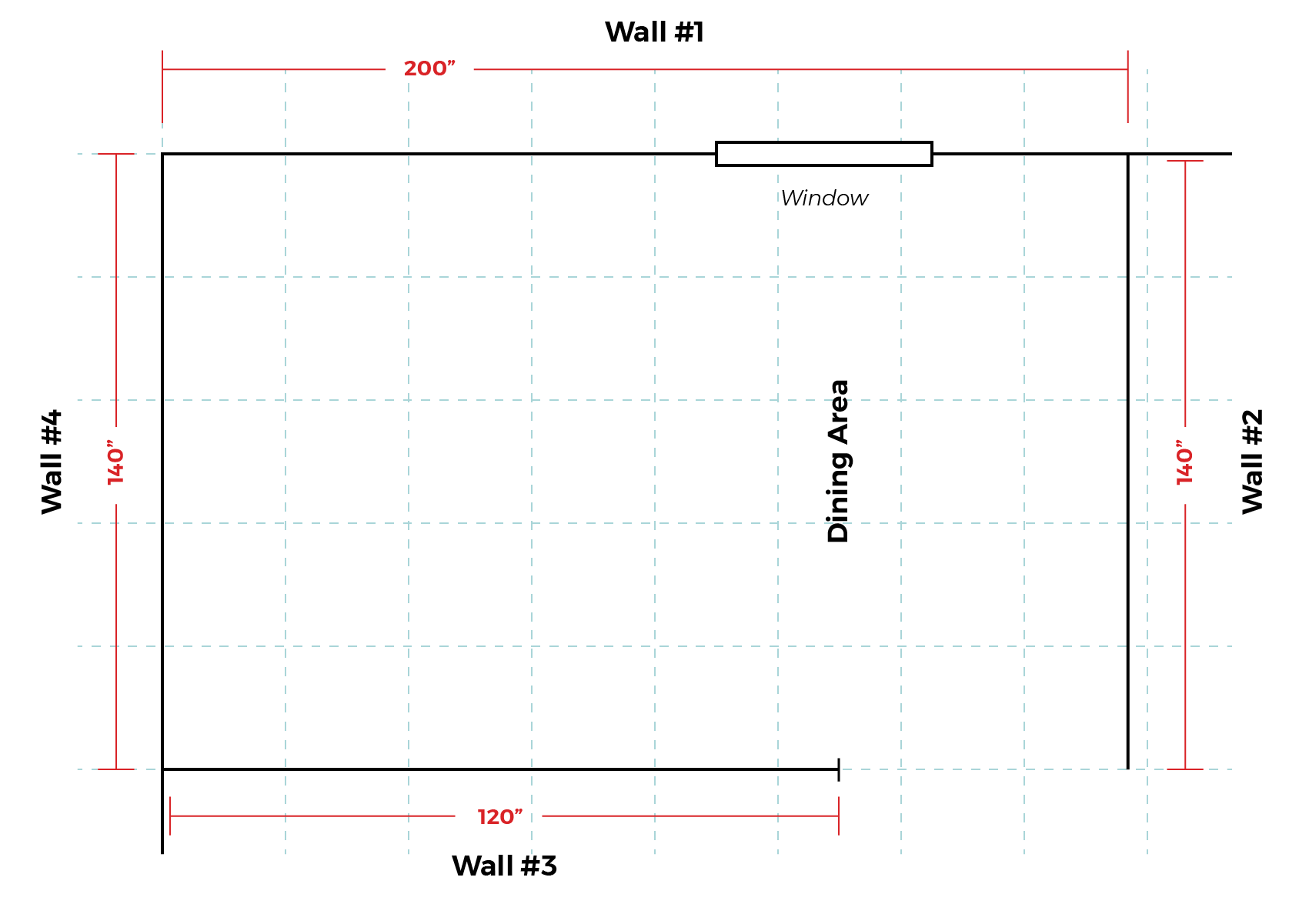
Accurate wall measurements will ensure your new cabinets and appliances fit perfectly into your updated kitchen layout. To measure the length of your walls:
- Start from an adjoining corner of the wall and work clockwise, taking horizontal measurements of the wall at 36-inch height.
- Measure from one edge of the wall to the other, skipping over any windows, appliances, or fixtures.
- Label each of the walls with a number for easy reference.
Walls are rarely perfectly square, especially in older homes. Measure each wall at three heights: near the floor, at 36 inches, and near the ceiling. Use the smallest measurement when ordering cabinets. To check if corners are square, measure 3 feet out from the corner along one wall and 4 feet out along the adjacent wall. The diagonal between those two points should measure exactly 5 feet. If it does not, your walls are out of square and you may need filler strips during installation.
How to Measure Openings and Small Wall Sections
After recording the entire wall lengths, measure the wall in smaller segments. For example, from a corner of the wall to the outside trim of a window.
- Measure all openings, such as windows or doors, from one outside trim edge to the other outside trim edge. Any trim or molding around it should be part of the measurement.
- Number each opening so it is easy to reference later.
Double-check your kitchen measurements when you are done to ensure accuracy. Many designers recommend the "measure twice, order once" rule for a reason.
3. Record Your Vertical Measurements
Knowing the height of your space will help you decide how high or low to install your wall cabinets. Typically, upper cabinets hang about 18 inches above your countertop. Ceiling height also determines which standard cabinet dimensions will work in your space.
Measure and record these heights into your floor plan:
- Inches from the floor to the windowsill
- Inches from the windowsill to the top of the window
- Inches from the top of the window to the ceiling
Next, measure from the floor to ceiling in at least three different spots of your kitchen. This is especially important in older homes since ceiling heights can vary.
If you have a recessed ceiling or soffit, measure the height and depth and make a note on your floor plan. Soffits significantly limit your upper cabinet height options.
4. Mark Obstructions
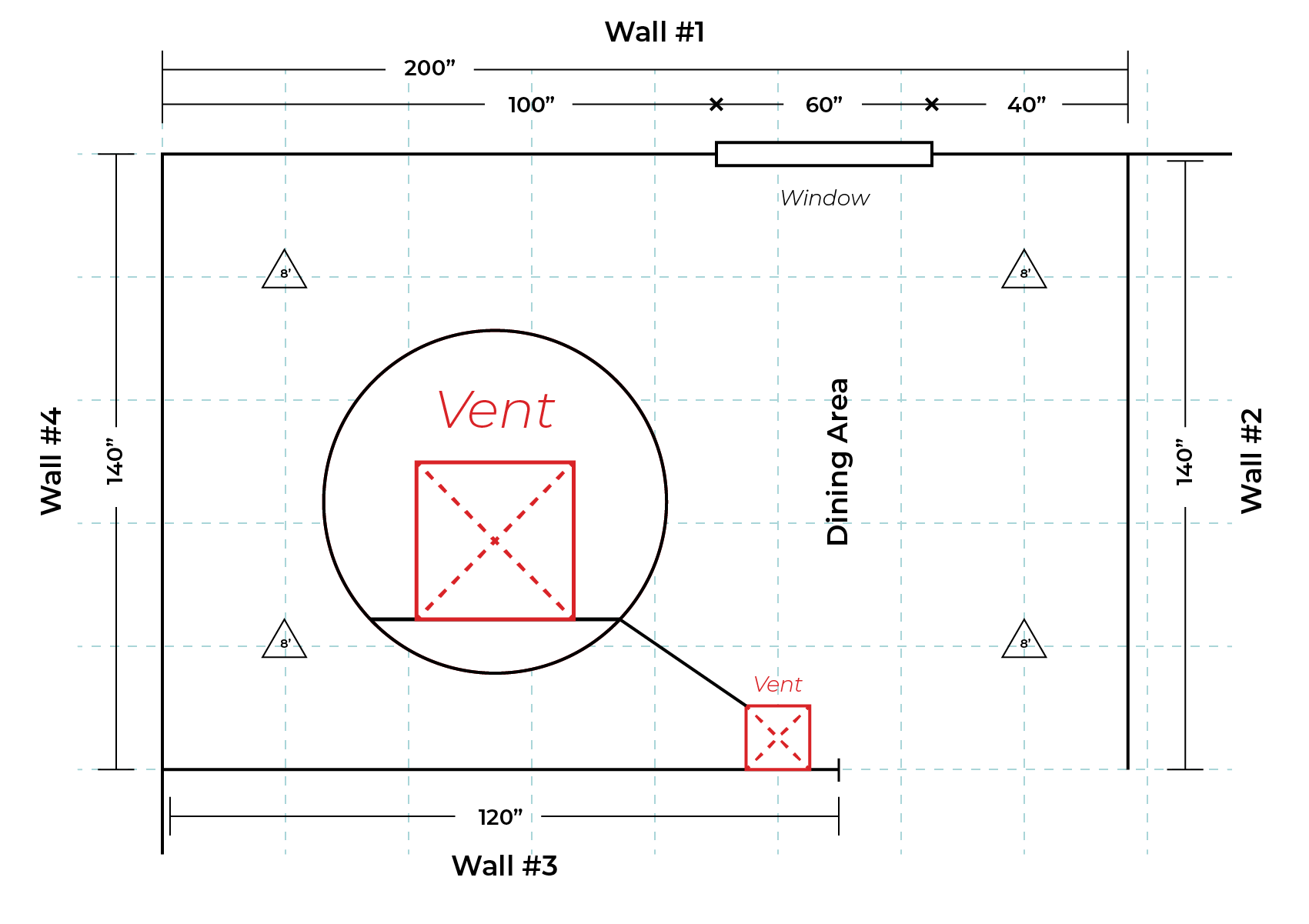
Radiators, pipes, and vents are common obstructions that should be recorded, as they usually cannot be removed when it comes time to install your new cabinets. Use the provided key and carefully label any and all obstructions.
A common obstruction to label is a heat vent in the base area of your kitchen cabinets. These vents need to remain accessible and usually cannot be covered by cabinet bases.
5. Place Appliances and Utilities
Identify all large appliances, fixtures, furniture, and anything else you plan to keep after laying out your new kitchen cabinets. Account for appliance clearances too, because the refrigerator door swing, dishwasher door drop, and range landing zones all affect where cabinets can go. Utilities to make note of include:
- Your water supply
- Any power sources
- Heating or air vents
- Electrical outlets
- Light switches
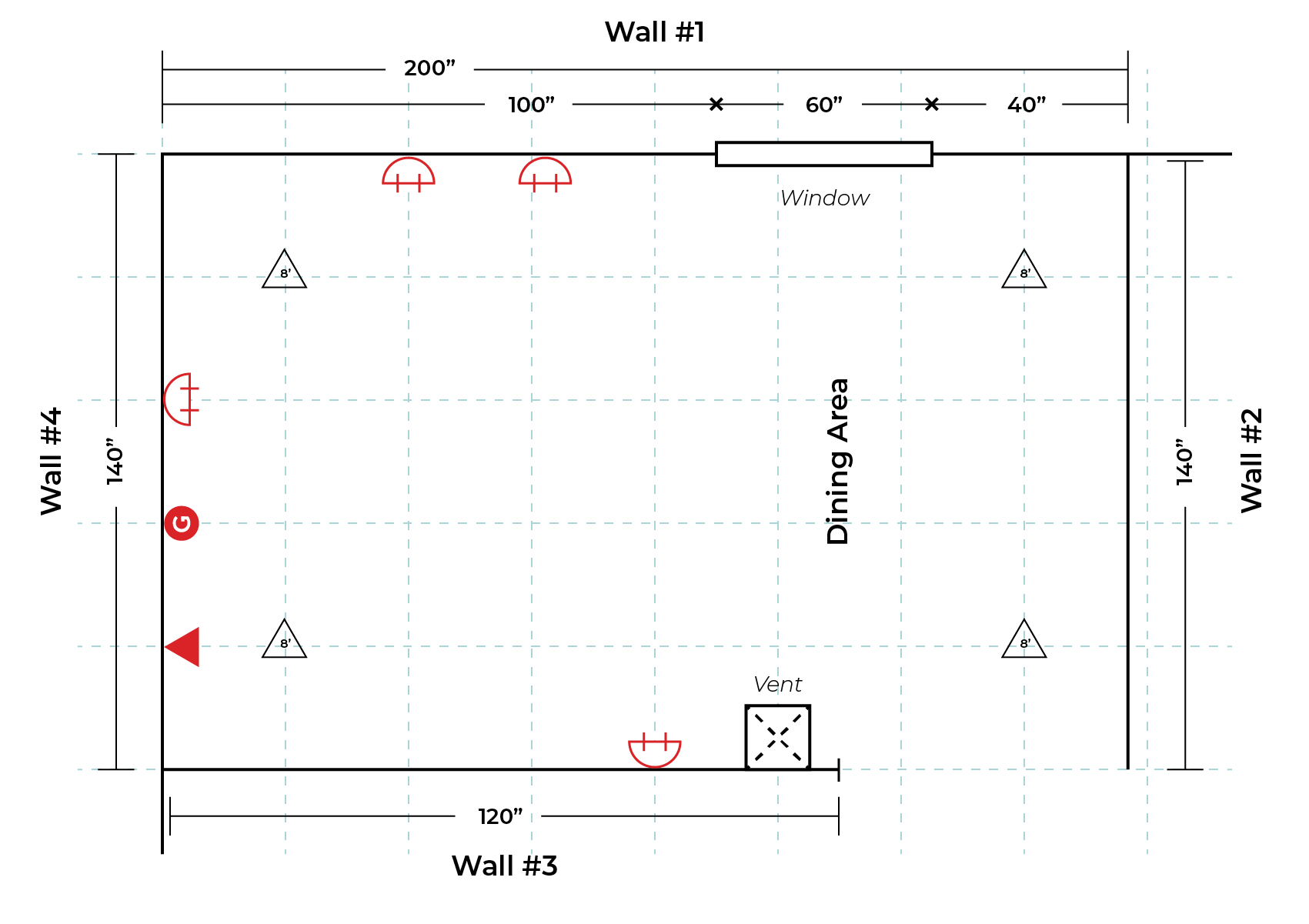
Mark the location and center point of all your permanent features.
The center point of appliances is often where the plumbing line or gas line starts. When in doubt, measure to the visible utility connection.
6. Choose Your Kitchen Layout
Your completed floor plan should resemble the example below. Be sure to double-check that your kitchen layout measurements are accurate and all obstructions and appliances have been included.
Now that you know how much space you have to work with, you can start planning your kitchen layout. The six most popular cabinet configurations to choose from are:
If your kitchen is larger than 10 by 10 feet, you should have enough room to accommodate any of these layouts. However, the best kitchen layout for your space will depend on how you plan to use it. For example, galley kitchens prioritize efficiency in small kitchens, while G-shaped layouts can help close off a kitchen in a large open-concept space.
Before you settle on your new floor plan, consider what issues you have with your current kitchen and how you can address them with a layout tailored to your needs.
Account for and measure your desired appliances when planning your kitchen layout. Refrigerator depths, range widths, and dishwasher clearances all affect cabinet sizing.
7. Shop for Kitchen Cabinets
Once you have accurate measurements and a plan for your cabinet layout, you can easily narrow down quality cabinets by size, including length, width, and depth.
To find out which cabinets work best in your kitchen, reference our kitchen cabinet size guide. It provides an in-depth look at standard cabinet depths and heights. The base, wall, or tall cabinets you choose will depend on your storage needs and design preferences.
Start with our selection of stunning kitchen cabinets at wholesale prices.
Whether you prefer assembled kitchen cabinets or ready-to-assemble kitchen cabinets, there are cabinet door styles that will pair with any kitchen theme.
How to Measure Cabinet Doors for Replacement
If you are refacing your kitchen instead of replacing full cabinets, you only need to measure for new cabinet doors. This is a budget-friendly way to refresh your kitchen without a full remodel, and the measuring process is straightforward once you understand cabinet door overlay.
Understanding Cabinet Door Overlay
Overlay refers to how much the door covers the cabinet frame when closed. There are three common types:
- Full overlay: The door covers almost the entire cabinet frame, leaving only a small gap between doors. Most modern frameless cabinets use full overlay.
- Partial overlay: The door covers part of the frame but leaves visible frame between doors. This is the most common style for traditional framed cabinets.
- Inset: The door sits flush inside the cabinet frame opening, not overlapping at all. Inset doors require the most precise measurements.
Measuring for Replacement Doors
- Measure the cabinet frame opening (not the existing door) to the nearest 1/16 inch. Measure both width and height.
- Determine your overlay type by noting how much of the frame the current door covers on each side.
- Add the overlay to your opening measurement. For a standard 1/2-inch overlay on all sides, add 1 inch to both the width and the height of the frame opening.
- Measure the existing door as a double-check. Your calculated door size should match the existing door within 1/16 inch.
- Note the hinge type (soft-close, self-close, European concealed) so replacement hardware matches.
If you are unsure about your overlay type, order a refundable cabinet door sample first. You can test-fit the sample on your existing frame before ordering an entire set of replacement doors.
Common Kitchen Measurement Mistakes to Avoid
Even experienced DIYers make avoidable mistakes when measuring for new kitchen cabinets. These are the most common errors we see and how to prevent them.
Measuring at only one height. Walls are almost never perfectly plumb. Always measure each wall at three heights: near the floor, at countertop level (36 inches), and near the ceiling. Use the smallest measurement when ordering cabinets.
Forgetting filler strips. Cabinet runs almost always need a small filler between the end cabinet and the wall, especially in corners where walls are out of square. Leave about 1.5 inches of space in your plan for filler strips on both sides of a run.
Ignoring appliance handles and trim. The spec sheet dimensions for your refrigerator do not include handles, and handles can add 2 to 3 inches of depth. Always measure your actual appliance with handles attached, then add 1 inch of ventilation clearance on each side.
Not accounting for countertop overhang. Standard countertop overhang is 1.5 inches beyond the base cabinet face. Factor that in when planning clearances around appliances, doorways, and walkways.
Skipping the diagonal cross-check. Measure from opposite corners of the room to confirm walls are square. If the diagonal measurements are not equal, your room is out of square and your cabinet layout needs to account for it with fillers or custom cuts.
How To Measure Kitchen Cabinets FAQs
Still stuck on how to measure for your new cabinets? We answered the most frequently asked questions about kitchen cabinet measurements below. Click any question to expand the answer.
What are standard cabinet measurements?
If you are planning on purchasing stock kitchen cabinets, standard cabinet measurements for the main three types of kitchen cabinets are as follows:
- Height
- 24 - 34 1/2"
- Width
- 9 - 42"
- Depth
- 24"
- Height
- 30, 36, 42"
- Width
- 12 - 36"
- Depth
- 12, 24"
- Height
- 84, 90, 96"
- Width
- 18 - 36"
- Depth
- 12, 24"
Do you measure kitchen cabinets from the inside or outside?
Measure kitchen cabinets from the outside to get accurate dimensions. Include the full width, height, and depth of the cabinet box, not the interior space.
If you are measuring existing cabinets for replacement, always measure the cabinet box rather than the door or hardware, since those extend beyond the actual cabinet dimensions and will throw off your numbers.
Do you measure kitchen cabinets in inches or feet?
Always measure kitchen cabinets in inches, not feet. Recording your measurements strictly in inches (for example, writing 42" instead of 3' 6") eliminates math errors and aligns perfectly with how cabinet manufacturers size their products.
Mixing feet and inches is one of the most common sources of ordering mistakes, especially when working with online cabinet retailers.
How do you calculate linear feet for kitchen cabinets?
To find your linear footage, measure the length of each wall where base cabinets will be installed in inches, add those numbers together, and divide by 12.
For example, if your total wall length for cabinets is 240 inches, you have 20 linear feet of base cabinets. Linear feet is the standard measurement used for cabinet pricing and contractor quotes.
Do you include trim and molding when measuring doors and windows?
Yes. When measuring doors and windows for a kitchen layout, measure from the outside edge of the trim or molding, not the bare opening. Trim affects where cabinets can be placed, so it must be included to avoid cabinets that block or interfere with door and window frames.
How do you measure a corner cabinet?
Corner cabinets come in many shapes, which means measuring requires a few extra steps to determine the correct size for your layout. Follow these instructions to measure your corner cabinets:
- Measure the length: Start by measuring the back of one side of the cabinet (from back corner to middle edge), then do the same on the other side. These measurements are typically the same, but they do not have to be.
- Measure the width: Then, measure the depth from the back corner to the front corner. These measurements should be the same for both.
- Measure the height: Finally, measure from the top to the bottom edge of the cabinet.
How do you measure cabinet doors for replacement?
To measure for new cabinet doors, first measure the width and height of the cabinet frame opening to the nearest 1/16 inch. Do not measure the existing door itself.
Then determine your overlay type (full, partial, or inset) and add the overlay amount to your opening measurement. For a standard 1/2 inch overlay on all sides, add 1 inch to both the width and height of the frame opening to get your final door size.
What if my kitchen walls are not square?
Most kitchen walls are at least slightly out of square, especially in older homes. Check corner squareness using the 3-4-5 method: measure 3 feet out from the corner along one wall and 4 feet out along the adjacent wall. The diagonal between those two points should measure exactly 5 feet.
If your measurement is off, your walls are out of square. Plan for filler strips of about 1.5 inches on each end of your cabinet runs to accommodate the variance during installation.
What tools do I need to measure my kitchen for cabinets?
You need six basic tools:
- A 25-foot steel tape measure
- Graph paper or a printable grid layout
- A pencil with an eraser
- A 2-foot level to check for uneven walls and floors
- A step stool for reaching ceilings and upper wall sections
- A smartphone for photographing each wall as a visual backup
Our downloadable PDF guide includes a pre-formatted grid layout if you do not have graph paper on hand.
Should I measure my existing cabinets if I am keeping the same layout?
Yes. If you are keeping the same kitchen footprint, measure your existing cabinets in addition to the walls. Record the width, height, and depth of each existing cabinet so you can order replacements in matching sizes.
Measure the cabinet box from the outside, not the doors or hardware. Also note the location of any custom features like drawer configurations, pull-outs, or lazy Susans.
Should upper and lower cabinets be the same size?
Upper and lower cabinets are usually not the same size. Because your eyes move side to side instead of up and down when taking in a room, your wall and base cabinets are on different planes. This means trying to get your upper and lower cabinets to "match up" will not have much of an impact stylistically. It is also often functionally impossible due to how appliances are placed within the base cabinets.
When choosing various cabinet sizes for your upper and lower cabinets, focus on functionality for your bottom cabinets and create a balanced arrangement for your wall cabinets.
How many inches should cabinets be from the countertop?
The National Kitchen and Bath Association (NKBA) recommends hanging wall cabinets at least 18 inches above the countertop. This provides plenty of workspace for food prep while keeping stored goods and supplies at eye height. Anything higher than 20 to 22 inches may make storage out of reach.
However, older homes usually have upper cabinets just 16 inches above the countertop, so measure your existing setup before assuming the standard applies.
What measurements does a kitchen designer need from me?
A kitchen designer needs a complete picture of your space to plan an accurate layout. Provide the following:
- A full floor plan sketch with every wall length
- Ceiling height measured in at least three spots
- Window and door locations with trim included
- All appliance and utility positions with center points marked
- Any obstructions like soffits, radiators, or vents
- Photos of each wall as a visual reference
If you want free 3D design help, our team can create a customized layout from your measurements. Start your free 3D design to get paired with a certified designer.
This simple guide will help you learn how to measure your kitchen for cabinets with ease and make the design process more enjoyable. Once you are done with measurements and layout planning, you can start gathering design inspiration and piecing together your dream kitchen mood board. Take the time to research all of your kitchen cabinet options and find the perfect door style and size for your space.
If you are looking for free 3D kitchen design advice, our team of professionals can design a carefully customized and functional kitchen layout that revolves around your specific kitchen dimensions, preferences, and needs.