

Wall-Mounted Faucet Pros and Cons: What to Know Before Your Remodel

by Andrew Saladino
June 22, 2026
If you are planning a kitchen or bathroom remodel, the faucet is one of those decisions that seems small until you start researching. Wall-mounted faucets (where the spout and handles come out of the wall instead of sitting on the countertop) have become increasingly popular in modern homes, and for good reason. They look clean, they free up counter space, and they give you design flexibility that a standard deck-mounted faucet cannot match.
But they also come with trade-offs. The installation is more complex, repairs are harder, and the cost is higher. Whether a wall-mounted faucet is the right choice for your space depends on your budget, your layout, and how much future flexibility you need.
This guide breaks down every pro and con, covers the real costs, and helps you decide whether wall-mounted faucets belong in your remodel.
What Is a Wall-Mounted Faucet?
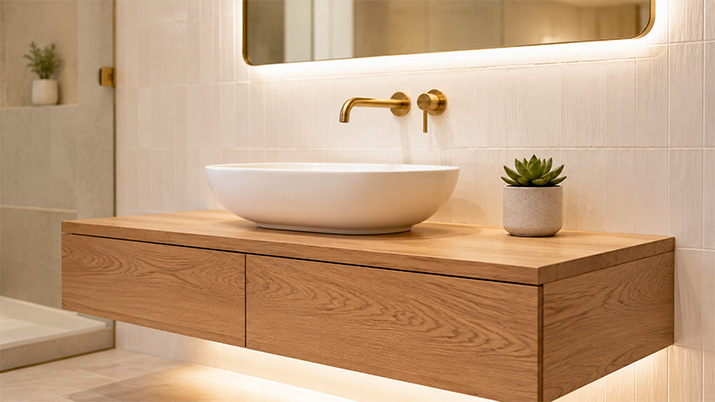
A wall-mounted faucet attaches to the wall above the sink rather than sitting on the countertop or sink deck. The spout and handles extend from the wall, and the water supply lines run behind the wall rather than under the sink. The result is a floating look where nothing touches the counter surface except the sink itself.
This design has been standard in European bathrooms for decades and has gained popularity in North American kitchens and bathrooms as modern and minimalist styles have taken hold. You will find wall-mounted options in every finish (brushed nickel, matte black, polished chrome, brass) and in single-handle, double-handle, and bridge configurations.
The alternative is a deck-mounted faucet, which is what most homes have: the faucet mounts through holes drilled in the countertop or the sink itself, with the supply lines running down through the counter and connecting under the sink inside the cabinet.
7 Pros of Wall-Mounted Faucets
1. More Counter Space
This is the most obvious and most cited advantage. A deck-mounted faucet and its base plate occupy several inches of counter space directly behind the sink. A wall-mounted faucet moves all of that to the wall, leaving the counter surface completely clear. In a small bathroom or a compact kitchen, those few inches of reclaimed counter space make a visible difference in how open and usable the area feels.
2. Easier to Clean Around the Sink
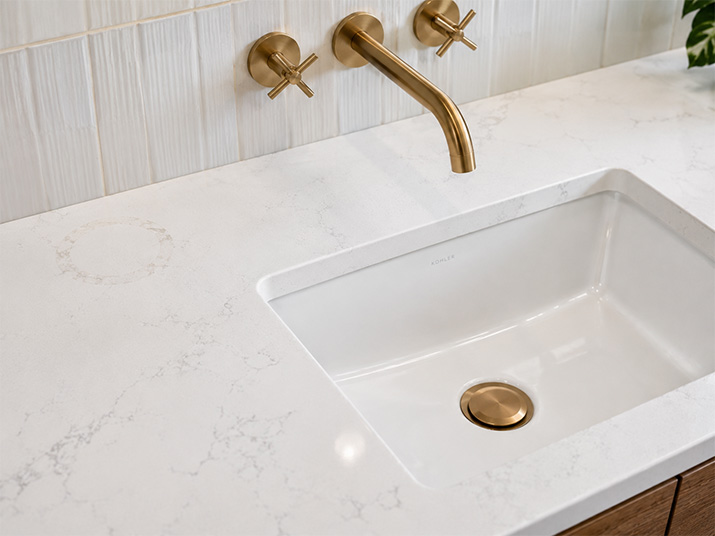
Anyone who has cleaned around a deck-mounted faucet knows the frustration. Water pools at the base, mineral deposits build up in the crevice between the faucet and the counter, and soap scum collects in spots your cloth cannot reach without contorting your hand. With a wall-mounted faucet, none of that exists. The counter behind the sink is a flat, uninterrupted surface that you can wipe clean in one pass.
3. Adjustable Installation Height
Deck-mounted faucets are locked to the height of the counter. Wall-mounted faucets can be positioned at whatever height works best for your sink, your pots, or your daily use. In a kitchen, mounting the faucet higher gives you clearance to fill tall stock pots without tilting them sideways. In a bathroom with a vessel sink (which sits on top of the counter rather than dropping into it), a wall-mounted faucet can be positioned at the perfect height to avoid splashing.
This flexibility is especially useful for non-standard setups where a deck-mounted faucet would be too low or too high for the sink.
4. More Storage Under the Sink
Deck-mounted faucets have supply lines that run down through the counter and connect inside the cabinet below. Those lines, along with the mounting hardware and shut-off valves, eat into the usable storage space under your sink. A wall-mounted faucet routes all of its plumbing behind the wall, which keeps the interior of the base cabinet more open. You get the full depth and width of the cabinet for cleaning supplies, dish soap, or whatever else lives under your sink.
If you are planning a bathroom remodel with a wall-hung bathroom vanity, the combination of a floating vanity and a wall-mounted faucet maximizes both the visual openness and the usable storage inside the cabinet.
5. No Holes in Your Countertop
Every deck-mounted faucet requires one to three holes drilled through the countertop. On a $5,000 marble or quartz slab, those holes are permanent modifications that cannot be undone. If you ever change faucet styles, you are stuck with the original hole pattern unless you replace the entire countertop.
A wall-mounted faucet leaves the counter intact. The mounting goes through the wall tile or drywall, which is far cheaper and easier to repair or modify than a stone countertop. For homeowners investing in premium counter materials, this is a meaningful advantage.
6. Works With Multiple Sink Types
Wall-mounted faucets pair well with sink styles that deck-mounted faucets sometimes struggle with. Vessel sinks (which sit on top of the counter) often need a special tall deck-mounted faucet to reach over the rim. A wall-mounted faucet eliminates that problem because the spout comes from the wall at whatever height you need. Farmhouse sinks, undermount sinks, and trough sinks all work well with wall-mounted faucets too, because the faucet position is independent of the sink geometry.
7. Strong Design Statement
There is no getting around the aesthetic appeal. A wall-mounted faucet creates a clean, intentional look that reads as designed rather than default. The floating spout, the uncluttered counter, and the visible wall mounting all signal that someone thought carefully about this space. In a bathroom or kitchen where you want the fixtures to contribute to the overall design rather than blend into the background, a wall-mounted faucet delivers.
7 Cons of Wall-Mounted Faucets
1. Higher Installation Cost
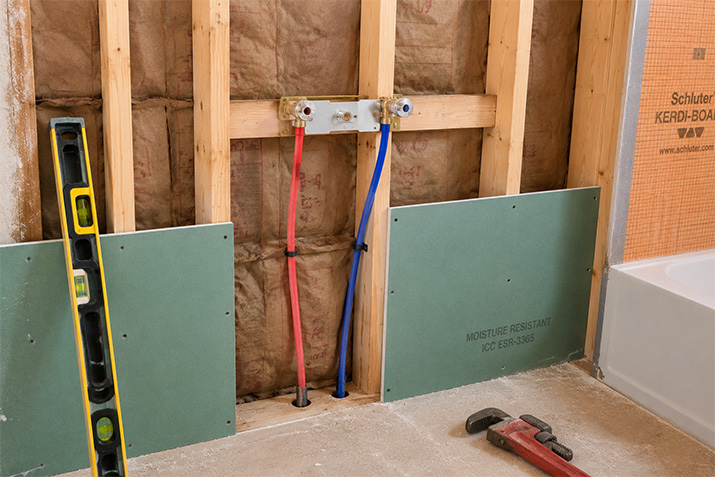
This is the biggest practical downside. A deck-mounted faucet installs through pre-drilled holes in the counter in under an hour. A wall-mounted faucet requires routing water supply lines through the wall cavity, installing a rough-in valve behind the wall, and then closing the wall back up with drywall and tile before the faucet trim can be mounted. That means plumbing work, drywall work, and possibly tile work, all for one faucet.
According to Angi, the faucet fixture itself typically costs $100 to $400 for standard models, with high-end designs running $1,000 or more. Installation labor adds $200 to $500 on top of that, depending on whether the wall is already open (during a remodel) or needs to be opened specifically for the faucet. If you are doing a full bathroom or kitchen remodel and the walls are already open, the incremental cost of wall-mounting is much lower than retrofitting into a finished wall.
2. Harder to Repair
When a deck-mounted faucet leaks, you open the cabinet below, access the connections, and fix the problem. When a wall-mounted faucet leaks, the valve body and connections are behind the wall. Fixing a leak may require cutting open drywall, removing tile, or accessing the wall from an adjacent room. The repair itself might take the same amount of time as a deck-mounted faucet, but the wall access and restoration add significant cost and disruption.
This is a strong argument for buying a quality faucet from a reputable manufacturer rather than saving $50 on a no-name brand. A reliable valve body that does not develop leaks for 15 to 20 years is worth the upfront investment when the alternative is opening a wall to fix a $12 cartridge.
3. Hidden Leak Risk
This is related to the repair issue but deserves its own mention because the consequences are different. If a deck-mounted faucet leaks, you see water pooling under the sink. If a wall-mounted faucet leaks behind the wall, the water drains into the wall cavity. You might not notice the leak for weeks or months, by which point it has damaged the drywall, the framing, and potentially the flooring below. Mold can develop inside the wall before any visible signs appear on the exterior surface.
The mitigation is straightforward: hire a licensed plumber for the installation, use a high-quality rough-in valve, and pressure-test the connections before the wall is closed up. Some plumbers also install an access panel behind the faucet (often on the other side of the wall or in an adjacent closet) so the valve body can be reached without demolishing the finished wall surface.
4. Height Mistakes Cause Splashing
The adjustable height that makes wall-mounted faucets flexible (Pro #3) is also a risk. If the faucet is mounted too high, water falls a long distance into the sink and splashes out onto the counter, the wall, and you. If it is mounted too low, you cannot fit large pots or your hands comfortably under the stream.
The critical dimension is typically 6 to 8 inches above the countertop for bathroom faucets and 8 to 10 inches for kitchen faucets, but the right height depends on your specific sink depth and shape. Flatter sinks splash more than deeper bowls. Once the plumbing is set in the wall and the wall is closed up, adjusting the height is expensive. This is a measurement you need to get right the first time.
5. Not Compatible With Every Layout
Wall-mounted faucets need a wall directly behind the sink with enough depth to house the plumbing. If your sink is in a kitchen island, a peninsula, or positioned under a window with a shallow sill, wall-mounting may not be feasible without significant structural modifications. The wall also needs to be positioned between studs at the right spacing for the faucet’s rough-in bracket, and the plumbing run needs to connect to your supply lines without excessive rerouting.
Before falling in love with a wall-mounted faucet, confirm with your plumber that your wall can accommodate the installation. This is a conversation to have during the design phase, not after the tile is up.
6. Limited Future Flexibility
Once the plumbing is set in the wall at a specific height and position, changing anything is expensive. If you want to swap to a deck-mounted faucet later, you need to cap the in-wall lines, patch the wall, and drill new holes in the counter. If you want to move the sink to a different wall, the old faucet location needs to be patched and the new one roughed in. Deck-mounted faucets, by contrast, can be swapped in minutes because all the connections are under the sink.
If you are confident in your layout and design direction, this is not a concern. If you tend to change your mind or if you are in a home you may sell soon, the permanence of wall-mounted plumbing is worth considering.
7. Freezing Risk on Exterior Walls
If your sink is on an exterior wall (a wall that faces the outside of the house), the water lines running through that wall cavity are exposed to cold temperatures in winter. In climates where temperatures drop below freezing, in-wall supply lines can freeze and burst. Deck-mounted faucets have their supply lines inside the heated cabinet space, which is naturally warmer.
If you live in a cold-climate region and want a wall-mounted faucet on an exterior wall, your plumber should insulate the pipes with spray foam or pipe insulation and position the lines as far from the exterior sheathing as possible. This adds cost but eliminates the freeze risk.
Wall-Mounted vs. Deck-Mounted Faucets: A Quick Comparison
If you are weighing the two options side by side, here is how they compare on the factors that matter most:
Installation complexity: Deck-mounted is straightforward, often a DIY project. Wall-mounted requires a licensed plumber and open wall access.
Installation cost: Deck-mounted runs $150 to $300 total (faucet plus labor or DIY). Wall-mounted runs $300 to $1,500 depending on the fixture quality and whether the wall is already open.
Counter space: Deck-mounted occupies several inches behind the sink. Wall-mounted leaves the counter completely clear.
Cleaning: Deck-mounted requires cleaning around the faucet base where grime collects. Wall-mounted has a flat, uninterrupted counter surface.
Repairs: Deck-mounted repairs are accessed under the sink. Wall-mounted repairs require accessing the wall cavity.
Flexibility: Deck-mounted faucets can be swapped in minutes. Wall-mounted faucets are semi-permanent once the plumbing is set.
Aesthetics: Deck-mounted is the standard look. Wall-mounted is the statement look.
Sink compatibility: Deck-mounted needs pre-drilled holes in the counter or sink. Wall-mounted works with any sink type regardless of hole configuration.
How High Should a Wall-Mounted Faucet Be?
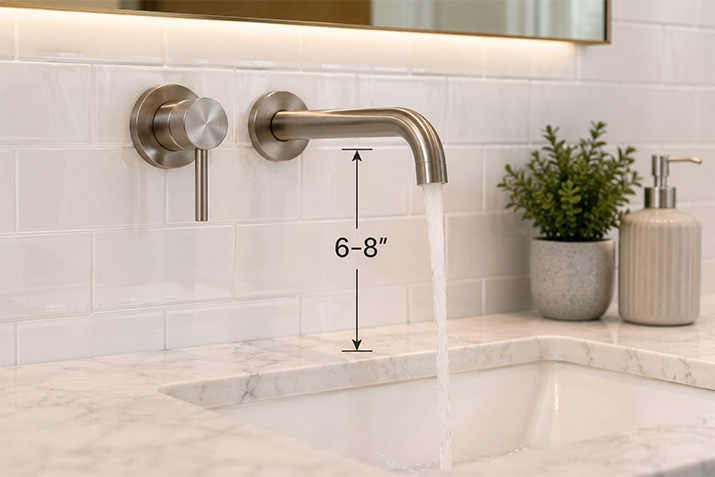
Getting the height right is one of the most important decisions you will make during installation, and it needs to happen before the wall is closed up.
Bathroom faucets: Mount the spout 6 to 8 inches above the countertop. This gives you enough clearance to wash your hands comfortably while keeping the water stream short enough to avoid splashing. If you are using a vessel sink (which adds 4 to 6 inches of height above the counter), position the faucet so the spout clears the rim of the vessel by 2 to 3 inches.
Kitchen faucets: Mount the spout 8 to 10 inches above the countertop. Kitchens need more clearance to accommodate tall pots, stock pots, and large mixing bowls under the stream. If you use a deep farmhouse sink, you can go slightly lower because the sink basin provides more depth to absorb the fall.
The splash test: Before your plumber sets the final position, hold the faucet (or a piece of tape marking the spout location) at the proposed height and have someone pour water from that point into the sink. Watch where it hits and whether it splashes out. This five-minute test prevents a problem that would cost hundreds to fix after the wall is tiled.
Spout reach matters too. The water stream should hit the center of the sink basin, not the edge or the drain. Measure the horizontal distance from the wall to the center of the sink and choose a faucet with a spout length that matches. Too short and the water hits the back of the sink. Too long and it overshoots toward the front edge.
Wall-Mounted Faucets in the Kitchen vs. the Bathroom
The pros and cons apply to both rooms, but the practical considerations are different enough to think through separately.
In the kitchen: Wall-mounted kitchen faucets need to handle higher flow rates, accommodate large pots, and withstand heavier daily use. Most wall-mounted kitchen faucets are bridge-style (two handles with a connecting bar) rather than single-handle, which means you need more wall space for the installation. The height needs to be generous enough for your tallest pot. And because kitchens produce more splashing from dish washing and food prep, getting the height and sink depth right is critical. Kitchen faucets also benefit from a longer spout reach because kitchen sinks are typically deeper and wider than bathroom sinks.
In the bathroom: Wall-mounted bathroom faucets are more common, more widely available in different styles, and generally easier to install because the flow rates are lower and the sink sizes are smaller. They pair especially well with vessel sinks and floating vanities, creating a clean, spa-like look that is hard to achieve with a deck-mounted faucet. The height requirements are less demanding, and the splash risk is lower because you are not filling large pots.
If you are doing both a kitchen and a bathroom in the same remodel, coordinate the faucet finishes across both rooms for a cohesive look throughout the home.
What Vanity Works Best With a Wall-Mounted Faucet?
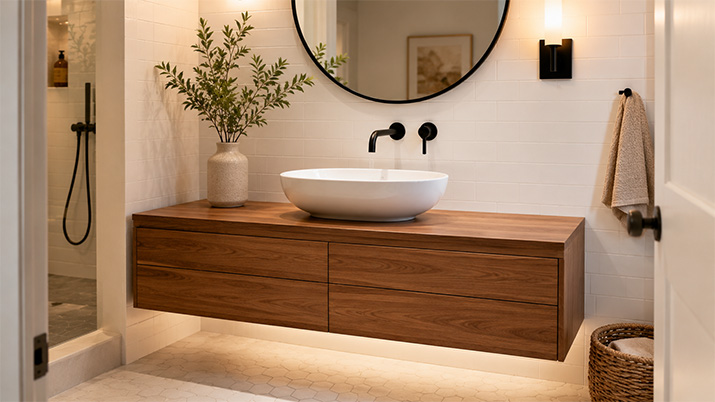
Wall-mounted faucets pair best with vanities that complement the floating, minimal aesthetic. The strongest combinations:
Floating (wall-hung) vanities. This is the most natural pairing. A vanity that floats on the wall combined with a faucet that comes out of the wall creates a room where nothing touches the floor except the toilet and the tile. The visual lightness makes the bathroom feel larger than it is. At Kitchen Cabinet Kings, our bathroom vanity cabinets include wall-hung options that work well in this configuration.
Vessel sink vanities. Vessel sinks sit on top of the counter, which means the faucet needs to be positioned higher than a standard undermount or drop-in setup. A wall-mounted faucet handles this naturally because you control the height during installation. Deck-mounted faucets for vessel sinks often require a special tall faucet, which limits your style options.
Open-shelf vanities. Vanities with open shelving below (rather than closed doors) pair well with wall-mounted faucets because the absence of visible plumbing lines under the sink keeps the open shelves looking clean.
If you are planning a bathroom remodel and want to see how wall-mounted faucets pair with specific vanity finishes, ordering a cabinet door sample lets you compare the vanity color and texture against your faucet finish in person before committing.
How Much Does a Wall-Mounted Faucet Cost?
Here is a realistic breakdown based on current pricing:
The faucet itself: $100 to $400 for standard residential models. $400 to $1,000+ for designer brands and premium finishes like unlacquered brass or matte black. Budget-friendly options from Delta, Moen, and Pfister start around $100 to $200. Mid-range options from Kohler and Grohe run $200 to $500. High-end options from Watermark, Kallista, and Rohl start at $500 and go well above $1,000.
Installation labor: $200 to $500 if the wall is already open during a remodel. $500 to $1,000+ if the wall needs to be opened, plumbed, and re-closed in a finished bathroom. The cost depends on whether you are adding wall-mounted plumbing to an existing wall (more expensive) or building the wall from scratch in new construction or a gut remodel (less expensive because the plumbing is installed before the wall is closed).
Total project cost: $300 to $900 for a standard faucet during a remodel where walls are already open. $600 to $2,000+ for a retrofit into a finished wall or for a premium faucet with complex installation.
For comparison, a deck-mounted faucet with installation typically runs $150 to $400 total. The wall-mounted option costs roughly 2x to 3x more than a comparable deck-mounted faucet when you factor in the installation complexity.
Is a Wall-Mounted Faucet Right for You?
A wall-mounted faucet is a strong choice if:
- You are doing a full remodel where the walls will be open anyway (this is the best time because it minimizes installation cost)
- You value a clean, minimal counter surface and are willing to pay more for it
- You are installing a vessel sink, a farmhouse sink, or another non-standard sink type
- You are investing in premium countertops and want to avoid drilling holes in the slab
- You plan to stay in the home long-term and are confident in the layout
A deck-mounted faucet is probably the better choice if:
- Your budget is tight and the extra installation cost does not make sense
- Your sink is on an exterior wall in a cold climate and you want to avoid freeze risk
- You want the flexibility to swap faucet styles easily in the future
- Your walls are already finished and opening them is not practical
- You are in a rental or a home you plan to sell within a few years
If you are in the middle of planning a bathroom or kitchen remodel and want help designing a layout that works with wall-mounted fixtures, our free 3D kitchen design service can map out the full room, including vanity placement, faucet positioning, and cabinet configuration. Browse our bathroom vanity collection to see which styles pair best with wall-mounted faucets, or explore our kitchen cabinet collection if your remodel extends beyond the sink area.
Frequently Asked Questions
What is a wall-mounted faucet?
A wall-mounted faucet attaches to the wall above the sink rather than sitting on the countertop. The spout and handles extend from the wall, and the water supply lines run behind the wall instead of under the sink. This creates a clean, floating look and leaves the counter surface completely clear around the sink.
How much does it cost to install a wall-mounted faucet?
The faucet itself typically costs $100 to $400 for standard models, with designer options running $500 to $1,000 or more. Installation labor adds $200 to $500 during a remodel where walls are open, or $500 to $1,000+ for a retrofit into a finished wall. Total project cost ranges from $300 to $2,000+ depending on the fixture, the wall condition, and local labor rates.
Are wall-mounted faucets hard to repair?
The faucet trim and handles are accessible from the front and can be repaired like any standard faucet. The challenge is the valve body and water connections, which sit behind the wall. If a leak develops at the valve, you may need to open the wall to access the plumbing, which means removing drywall or tile and then restoring it after the repair. Buying a high-quality faucet with a reliable valve body reduces the likelihood of needing in-wall repairs.
What height should a wall-mounted faucet be above the sink?
For bathroom faucets, mount the spout 6 to 8 inches above the countertop. For kitchen faucets, mount it 8 to 10 inches above the countertop to accommodate tall pots. For vessel sinks, position the spout 2 to 3 inches above the rim of the vessel. Always test the height before the wall is closed by simulating the water flow to check for splashing.
Do wall-mounted faucets splash more than deck-mounted?
They can if the height is not set correctly. The farther water falls from the spout into the sink, the more it splashes. Mounting the faucet too high is the most common cause of splash problems. Choosing a deeper sink and setting the faucet at the recommended height (6 to 8 inches for bathrooms, 8 to 10 for kitchens) minimizes splashing. Flatter, shallower sinks splash more than deeper bowls.
Does a wall-mounted faucet need a backsplash?
No. A wall-mounted faucet can be installed on tile, stone, drywall, or any wall surface. A tile backsplash is common behind wall-mounted faucets because the area around the spout is exposed to water spray, and tile protects the wall. But it is not a requirement. If you use drywall, make sure it is moisture-resistant (green board or cement board) in the splash zone.
Can you install a wall-mounted faucet on an exterior wall?
Yes, but with precautions in cold climates. Water supply lines running through an exterior wall cavity are vulnerable to freezing in winter. Your plumber should insulate the pipes with spray foam or pipe insulation and position them as far from the exterior sheathing as possible. In regions with mild winters, exterior wall installation is not a concern.
What type of sink works best with a wall-mounted faucet?
Wall-mounted faucets work with virtually any sink type: undermount, vessel, farmhouse, drop-in, and trough sinks. They are especially well-suited for vessel sinks (which sit on top of the counter and need a higher faucet position) and undermount sinks (which keep the counter surface clean and complement the minimalist aesthetic of a wall-mounted faucet).
Can I retrofit a wall-mounted faucet into an existing bathroom?
Technically yes, but it requires opening the wall behind the sink to route new supply lines, installing a rough-in valve, and then closing and refinishing the wall. This is significantly more expensive than installing during a remodel when the wall is already open. Consult with a plumber to get a realistic cost estimate for your specific layout before committing.
Are wall-mounted faucets worth it?
For homeowners doing a full remodel who value a clean, modern aesthetic and are willing to invest in quality fixtures, wall-mounted faucets are a strong upgrade. They free up counter space, simplify cleaning, and create a design statement that deck-mounted faucets cannot match. For quick faucet swaps or budget-conscious projects, a deck-mounted faucet delivers better value for the cost.

Andrew Saladino
Andrew Saladino co-founded Kitchen Cabinet Kings in 2010, and the company has since delivered cabinets for more than 110,000 kitchens. Named to the NKBA 30 Under 30 in 2013 and 2014, he writes about cabinet styles, construction, finishes, costs, lead times, and the ordering details that are easy to miss until the cabinets arrive.