

Are Toe-Kick Drawers Worth It? (And When to Skip Them)

by Andrew Saladino
August 17, 2026
Many kitchens have unused space hiding in plain sight.
The recessed area beneath your base cabinets, called the toe kick, gives your feet room while you work at the countertop. Adding toe-kick drawers can turn that gap into hidden storage. These shallow, push-to-open drawers can hold flat items such as baking sheets, placemats, and pet bowls.
Toe-kick drawers make the most sense in small kitchens, homes without a pantry, or kitchens that need more room for flat items used only occasionally. They add storage without increasing the cabinet footprint.
They aren’t the right upgrade for every home. Toe-kick drawers cost more than a standard toe-kick panel, require specialized hardware, and aren’t ideal for items you use every day. Other cabinet features may be a better use of the remodeling budget.
This guide covers the costs, trade-offs, and five standard cabinet alternatives that may stretch your budget further.
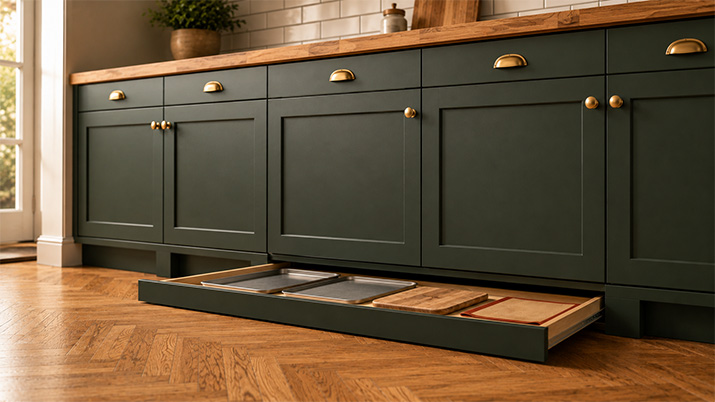
The Short Answer: Toe-kick drawers are most useful in small kitchens, homes without a pantry, and custom remodels where every inch counts. They turn dead space into storage for flat, occasional-use items such as baking sheets and serving platters. They cost $175 to $225 per drawer, hold items under about 4 inches tall, and require crouching to access. If you already have enough cabinet storage or find it uncomfortable to bend to floor level, deep drawer bases or vertical tray dividers may be a better use of your budget.
What Is a Toe-Kick Drawer?
A toe-kick drawer is a shallow drawer hidden behind the recessed area beneath your base cabinets. It replaces the fixed panel covering the cabinet plinth and stores thin, lightweight items. When closed, it looks like a standard toe-kick panel. Press the front with your foot, and the drawer pops open.
The recessed toe kick stays intact, so you can still stand comfortably at the countertop. Mounted on specialized slides, the drawer uses the empty space behind the foot clearance.
How the Drawer Fits Behind the Recessed Toe Kick
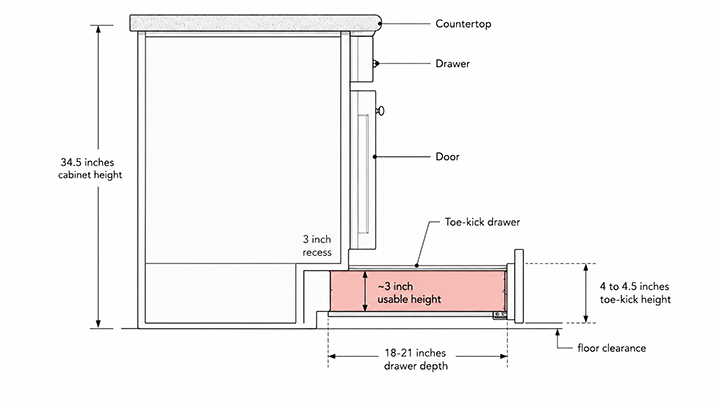
The toe-kick recess on most base cabinets is about 3 inches deep and 4 to 4.5 inches tall. Behind it, there are typically 18 to 21 inches of empty space running back to the wall. A toe-kick drawer uses that depth for storage while its front face stays recessed to preserve foot room.
The drawer box is usually about 3.5 to 4 inches tall, with closer to 3 inches of usable interior height. It can be up to 24 inches wide and as deep as the cabinet allows. The limited height still provides a sizable flat storage area across several base cabinets.
Push-to-Open Hardware
Because drawer pulls would interfere with foot clearance, most toe-kick drawers use mechanisms that keep the drawer nearly invisible:
- Push-to-open latches: Press the drawer face with your foot and it springs open a few inches, then you pull it the rest of the way out.
- Touch-release mechanisms: A lighter tap releases the latch. These tend to feel smoother but cost a bit more.
- Soft-close undermount slides: Paired with either latch type, these prevent the drawer from slamming shut and protect whatever’s stored inside.
Some homeowners choose a thin edge pull instead of a push latch. You hook your toe under a small lip to pull the drawer open. The pull is more visible but may feel more intuitive if you’ve never used a push-to-open mechanism.
Why Usable Height Is Limited
The standard toe-kick area is only 4 to 4.5 inches tall. Once you subtract the drawer box material, hardware, and floor clearance, you’re left with roughly 3 inches of usable interior height. Toe-kick drawers work best for flat items such as baking sheets, cutting boards, and placemats. Anything taller than a rolling pin won’t fit.
If you’re planning a remodel and want to understand how this space relates to your overall cabinet layout, our guide to standard kitchen cabinet sizes explains the dimensions that define every part of a base cabinet, toe kick included.
Toe-Kick Drawer Pros and Cons
Toe-kick drawers add storage, but their cost, location, and limited height come with trade-offs.
Extra storage without changing the cabinet footprint. Toe-kick drawers use space that would otherwise sit empty. In a small kitchen where every drawer and shelf is already in use, a few extra square feet of flat storage can help.
Nearly invisible when closed. A well-installed toe-kick drawer blends into the cabinetry. Most people won’t notice it unless you point it out, making it a useful spot for items you want to keep tucked away.
Good for flat, occasional-use items. Baking sheets, cutting boards, serving platters, placemats, table linens, aluminum foil and plastic wrap, pet bowls, emergency supplies (flashlights, batteries), appliance manuals, and folding step stools all fit well. If it’s flat and you don’t need it every day, it’s a candidate.
Higher cost than a standard toe-kick panel. Expect to pay $175 to $225 per drawer when ordering them with new cabinets. Retrofit installations on existing cabinets run around $150 per drawer for installation, plus the hardware. DIY kits are available on Amazon and Etsy starting around $74 per drawer, though quality varies. Either way, the cost adds up quickly if you’re putting them under every base cabinet in the kitchen.
They collect dust and moisture. Because they sit close to the floor, toe-kick drawers collect dust and debris faster than standard drawers. Moisture from mopping or spills can also cause problems if water pools along the cabinet base. Plan to wipe them out a few times a year.
You have to crouch or kneel to use them. Toe-kick drawers sit at floor level, so you have to bend down to reach them. That may be manageable for items you use once a month. For everyday items, a standard drawer at waist height is more practical.
A note on white cabinet finishes: White toe-kick drawer fronts can show scuff marks from shoes over time. Consider a darker or more durable finish for the drawer faces, or choose a push-to-open mechanism that requires less foot contact.
Common Mistake: Assuming the toe-kick space is empty. In many kitchens, the area beneath the cabinets is already occupied by HVAC floor vents, plumbing lines, electrical wiring, or structural supports. Before planning toe-kick drawers, check what’s actually down there. If the space is blocked, adding drawers may require rerouting utilities, which can quickly turn a $200 upgrade into a $2,000 problem.
What to Store in Toe-Kick Drawers
Flat items you don’t use every day are the best candidates. Store anything heavy, bulky, or frequently used somewhere easier to access.
Great for Toe-Kick Drawers
Avoid Storing in Toe-Kick Drawers
One Houzz user with 20 toe-kick drawers said their most-used drawer holds screwdrivers, pliers, scissors, and adhesives. Keeping these tools in the kitchen saves trips to the basement for quick fixes.
When Toe-Kick Drawers Are Worth It
Toe-kick drawers make the most sense when your traditional storage options are already maxed out and you’re looking for every extra inch.
Small Kitchens Where Every Inch Counts
In a galley kitchen or a compact L-shape where cabinets are limited, toe-kick drawers can provide meaningful extra capacity without adding a single new cabinet. If you’ve already optimized your shelves, drawers, and pantry (or don’t have a pantry at all), the space beneath your cabinets is one of the last untapped resources.
Homes Without Pantry Storage
Plenty of older homes were built without a dedicated pantry. Toe-kick drawers won’t replace one, but they can absorb some of the overflow: serving pieces, specialty bakeware, table linens, and seasonal items that don’t justify prime cabinet real estate.
Home Bakers With a Lot of Flat Tools
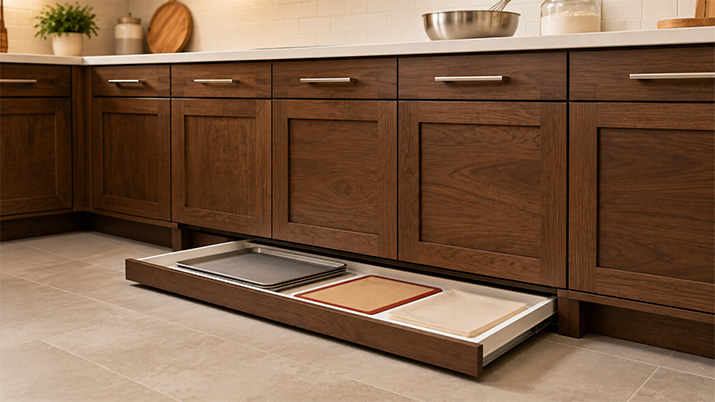
Bakers tend to accumulate flat, awkward items that don’t stack well in regular drawers: rolling pins, pastry mats, cookie sheets, cooling racks, cake pans, loaf tins, and decorating supplies. Toe-kick drawers suit this collection well. If your sheet pans avalanche every time you pull one out, a toe-kick drawer can keep them separated and easier to reach.
Custom Remodels Where the Budget Already Includes Cabinetry
If you’re already investing in custom or semi-custom cabinets, toe-kick drawers add a relatively small amount to the total cost. The hardware and installation are also easier to include during a full build than to retrofit later.
When to Skip Them
Toe-kick drawers aren’t automatically the best use of your remodeling budget. In some situations, the money goes further elsewhere.
You Already Have Adequate Storage
If your kitchen already has deep drawers, pull-out shelves, a pantry cabinet, and tray dividers, adding toe-kick drawers offers diminishing returns. In many cases, reorganizing what you already have (grouping baking supplies together, adding drawer dividers, moving rarely used items to upper cabinets) will make your kitchen more functional than adding storage to every unused gap.
Your Budget Is Tight
At $175 to $225 per drawer, four or five toe-kick drawers can cost $700 to $1,100. For the same money, you could upgrade several base cabinets to deep drawer bases, add roll-out trays to your existing cabinets, or install a narrow utility cabinet that holds far more than all those toe-kick drawers combined. If you’re choosing between toe-kick storage and everyday drawer upgrades, prioritize the features you’ll use daily.
Bending to Floor Level Is Difficult
If crouching or kneeling is uncomfortable because of age, injury, or mobility limitations, toe-kick drawers may go unused. Deep drawers at waist height provide a more comfortable and accessible place for the same items.
The Toe-Kick Space Is Already Occupied
Not every cabinet run can accommodate drawers underneath. HVAC floor vents, plumbing lines, electrical wiring, and structural supports all live in this zone. If the space is blocked, adding drawers means rerouting utilities or redesigning the layout, and the cost and complexity usually aren’t worth it for a few inches of storage.
5 Alternatives That Use Standard Cabinets
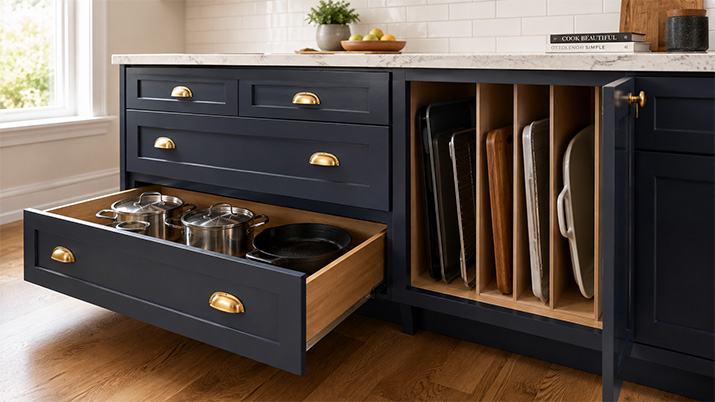
Several standard cabinet configurations provide more storage, easier access, and better value than toe-kick drawers.
Deep Drawer Bases
Deep drawer bases are one of the most practical upgrades you can make to a base cabinet layout. Instead of a traditional cabinet with a single door and a fixed shelf (where everything ends up in a dark pile at the back), large pull-out drawers keep pots, pans, mixing bowls, and small appliances organized and visible. You don’t have to crouch and dig. You pull the drawer toward you and see everything at once.
Roll-Out Trays
If you’re not replacing your cabinets, roll-out trays provide many of the same benefits as deep drawers inside your existing base cabinets. Pull the shelf toward you, and everything slides into view. They can make an older kitchen easier to use without the cost of replacing the cabinets.
Vertical Tray Dividers
If your goal is specifically storing flat items (baking sheets, cutting boards, serving trays, cooling racks), a dedicated tray-divider cabinet is often a better solution than toe-kick drawers. Everything stands upright in its own slot, so you can grab exactly what you need without unstacking anything. It’s the same items toe-kick drawers hold, stored at a more comfortable height.
Better Cabinet Zoning
You may not need another cabinet. Giving baking supplies, cookware, food storage containers, and serving pieces their own zones can free up usable space. It costs nothing and may work better than adding hidden drawers.
A Narrow Pantry or Utility Cabinet
If your layout has room for even a 12- or 15-inch-wide utility cabinet, it’ll hold more than a dozen toe-kick drawers combined. A single narrow pantry stores canned goods, cleaning supplies, spices, small appliances, and all those flat items that toe-kick drawers handle, and you don’t have to kneel to reach any of it.
If you’re comparing different storage solutions for your remodel, browse our kitchen cabinet collections to see which configurations fit your layout. And if you want to see a finish in person before deciding, order a few door samples for $19.99 each (refundable with your cabinet purchase) so you can compare in your own kitchen lighting.
Are Toe-Kick Drawers Worth It?
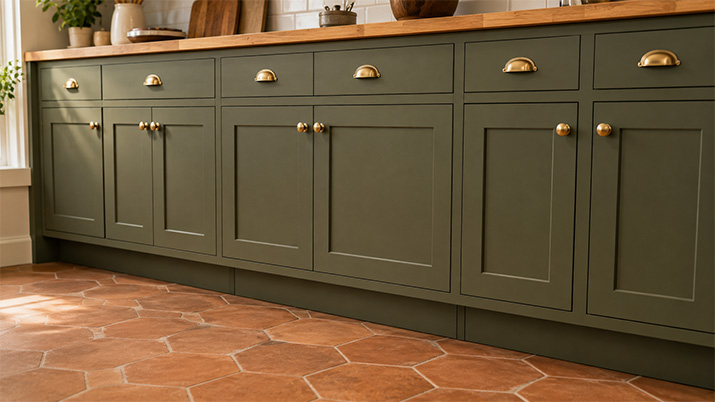
Toe-kick drawers reclaim space that would otherwise sit empty. They are most useful in small kitchens, homes without a pantry, and custom remodels where every inch of storage is planned. They work well for flat, occasional-use items such as baking sheets, serving platters, and emergency supplies.
They don’t replace well-designed drawers, pantry storage, or thoughtful cabinet organization. If you have the budget and need the extra space, they can be a useful finishing touch. If you have to choose between toe-kick drawers and storage you will use every day, prioritize the everyday storage.
Our free 3D kitchen design service can help you compare cabinet layouts, storage options, and organizational features before you order.
Frequently Asked Questions
What is a toe-kick drawer?
A toe-kick drawer is a shallow, hidden drawer built into the recessed space beneath your base cabinets. It opens with a push of your foot (using a push-latch or touch-release mechanism) and stores flat, lightweight items like baking sheets, cutting boards, and placemats. When closed, it looks like a standard toe-kick panel.
What can you store in a toe-kick drawer?
Anything flat and under about 3 inches tall: baking sheets, cutting boards, cooling racks, placemats, table linens, aluminum foil and plastic wrap, pet bowls, emergency supplies (flashlights, batteries), appliance manuals, folding step stools, and specialty kitchen tools you use a few times a year.
How much do toe-kick drawers cost?
Expect to pay $175 to $225 per drawer when ordering them with new cabinets. Retrofitting existing cabinets runs about $150 per drawer for installation. DIY kits are available starting around $74 per drawer, though quality varies. The cost adds up if you’re adding drawers under every base cabinet.
How tall is a toe-kick drawer?
The standard toe-kick area is 4 to 4.5 inches tall. After subtracting the drawer box material, hardware, and floor clearance, the usable interior height is roughly 3 inches. That’s enough for baking sheets and cutting boards but not for most kitchen tools or containers.
Can toe-kick drawers be added to existing cabinets?
Sometimes. Retrofit installations depend on cabinet construction, available floor clearance, and whether plumbing, HVAC vents, or structural supports occupy the space. They’re much easier and cheaper to include during a new cabinet installation than to add later. DIY retrofit kits are available but results vary based on your specific cabinets.
Can you DIY a toe-kick drawer?
Yes. Pre-made toe-kick drawer kits are available on Amazon and Etsy starting around $74 per drawer. You’ll need to confirm your cabinet dimensions, verify that the toe-kick space is clear of obstructions, and match the drawer front to your existing cabinet finish. It’s a manageable weekend project if you’re comfortable with basic tools.
Do toe-kick drawers get dirty?
They collect dust and debris faster than standard drawers because they sit at floor level. Regular floor cleaning helps, and wiping out the drawer interior a few times a year should keep it clean.
Do toe-kick drawers reduce foot space?
A properly installed toe-kick drawer preserves the recessed space your feet need to stand comfortably at the counter. The drawer sits behind the recess, not in it. Poorly designed installations can interfere with that clearance, so it’s worth confirming the specifications before ordering.
Can toe-kick drawers hold heavy items?
They’re better suited for lightweight, flat items. The weight capacity depends on the hardware, but storing heavy cast iron or large appliances isn’t recommended. The drawer slides and the cabinet structure aren’t designed for the same loads a standard base cabinet drawer handles.
Are toe-kick drawers good for accessibility?
Not usually. Because they require crouching or kneeling to access, they’re one of the least ergonomic storage locations in the kitchen. If bending to floor level is uncomfortable, deep drawers positioned at waist height are a more accessible alternative for the same items.
Are toe-kick drawers available in stock cabinets?
Rarely. Toe-kick drawers are primarily found in custom and semi-custom cabinet lines. Some manufacturers like KraftMaid offer them as a factory modification on specific cabinet sizes. Stock cabinet lines from big-box retailers generally don’t include them, though retrofit kits can sometimes be added after the fact.

Andrew Saladino
Andrew Saladino co-founded Kitchen Cabinet Kings in 2010, and the company has since delivered cabinets for more than 110,000 kitchens. Named to the NKBA 30 Under 30 in 2013 and 2014, he writes about cabinet styles, construction, finishes, costs, lead times, and the ordering details that are easy to miss until the cabinets arrive.