

Should You Paint Your Kitchen Cabinets? 9 Reasons to Think Twice

by Andrew Saladino
November 21, 2026
So your kitchen cabinets have seen better days. The finish is dated, the doors look tired, and every kitchen renovation photo you see makes you want to reach for a paintbrush.
But before you spend your weekend sanding cabinet doors, you may be asking yourself: Should I paint my kitchen cabinets, or would I be better off replacing them?
Painting can save thousands of dollars, and when your existing cabinets are in good condition, it can be a smart investment. But a fresh coat of paint won’t fix structural damage, awkward storage, or a kitchen layout you’ve hated for years.
That’s when it’s time to ask yourself two questions. First, are your cabinet boxes structurally sound, and second, does your kitchen layout work? If both answers are yes, painting might be a good option. But if either answer is no, you may be spending money to disguise a problem you’ll eventually have to fix.
Here’s how to decide whether to paint or replace kitchen cabinets, including nine reasons painting might leave you disappointed.
The short answer Should you paint your kitchen cabinets? Yes, if the boxes are sound, the layout works, and you like the door style. Plan on $200 to $600 for DIY supplies or $2,500 to $6,500 for a pro. Paint won’t fix sagging boxes, a layout that doesn’t work, or peeling thermofoil, and oak grain still shows through. If the boxes are beyond repair or the layout has to change, put that money toward new cabinets.
Should you paint or replace your kitchen cabinets?
Before you compare paint colors or request quotes, take a closer look at what you’re working with.
Open every cabinet and drawer. Check for water damage, sagging shelves, loose joints, swelling, and soft spots. Make sure the cabinets are securely attached to the walls and that the doors and drawers operate properly.
Then consider how the kitchen functions. Are you happy with the storage? Do you have enough drawers? Does the layout make cooking convenient?
Use this quick decision guide:

9 reasons you might regret painting your kitchen cabinets
Before you grab a paintbrush, consider what could go wrong. From peeling finishes to costly repairs, these nine issues can turn a budget-friendly kitchen update into an expensive mistake.
1. Your cabinet boxes are already damaged
Paint can cover scratches and discoloration, but it won’t fix deteriorating cabinets. Sagging boxes, loose joints, and water damage will still be there beneath the fresh finish.
Check the cabinets near the sink and dishwasher for moisture damage, especially swollen particleboard or MDF, which won’t return to its original shape after drying. Minor damage may be repairable, but if the boxes are falling apart, your money is better spent on replacement.
2. Your cabinets are made from difficult-to-paint materials
Can you paint laminate cabinets? Technically yes, but some materials are harder to paint than others. Solid wood and MDF generally accept paint better than laminate or thermofoil.
Laminate’s smooth, nonporous surface makes adhesion tricky, requiring careful preparation and a bonding primer. Thermofoil is even more challenging, especially when its vinyl coating starts peeling or bubbling. While specialty primers may help paint adhere to intact surfaces, results can be less durable. If the original coating is failing, replacing the doors is usually the better investment.
Not sure what your cabinets are made of? Check a door’s face and its edges. Whatever the material, paint still needs a clean surface, a light sanding, and the right primer.
| Material | Takes paint? | How to tell |
|---|---|---|
| Solid wood | Yes | Real wood grain, with end grain on the top and bottom edges. Check the frame and the center panel separately. |
| Oak | Yes, but the grain shows through | Deep, open grain you can feel with your fingertips. |
| MDF | Yes | Smooth, with no grain. A chipped spot shows fine, tan fibers. |
| Wood veneer | Yes, if it’s firmly attached. Sand lightly. | Real grain on the face, with a thin wood strip or a seam along the edges. |
| Laminate | Yes, if it’s intact, with a bonding primer | A hard, plastic feel, with seams at the edges. Wood-look patterns repeat from door to door. |
| Thermofoil | Difficult. Replace doors that are peeling. | Smooth vinyl wrapped over the edges, with no seams. Peeling often starts near the oven or dishwasher. |
| Swollen particleboard | No, replace it | Puffy, crumbly edges, usually under the sink. It won’t shrink back once it dries. |
For more on each material, see our guides to thermofoil cabinets and laminate vs. wood cabinets.
3. Paint won’t hide the grain on oak cabinets
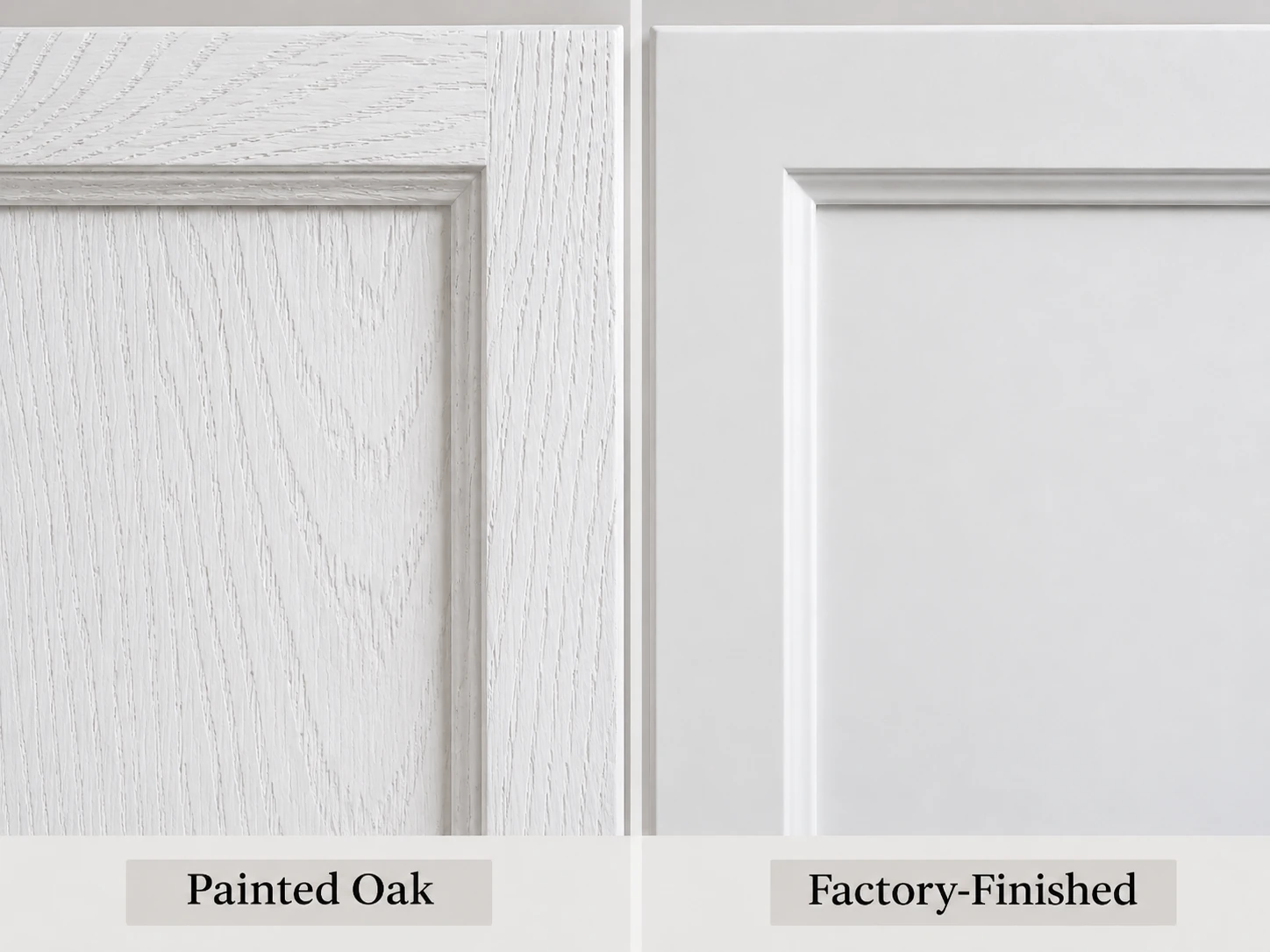
Painting honey-colored oak cabinets white can give your kitchen quite a nice facelift, but the wood grain won’t disappear. Oak’s deep pores often remain visible beneath paint, giving the finish a textured appearance.
If you prefer the smooth look of factory-painted cabinets, you’ll need extra preparation, including grain filler, sanding, and multiple coats of primer and paint. Even then, some texture may remain. Test one door before committing to the entire kitchen.
Like your oak but not how dated it looks? See how to make oak kitchen cabinets look modern without painting them.
4. Preparation takes much longer than painting
One of the biggest cabinet painting regrets is underestimating the prep work. Painting is the easy part. First, you’ll need to remove doors and hardware, clean off grease, repair damage, sand, prime, and allow everything to dry.
Skip a step, and you risk peeling paint, uneven coverage, or scratches. Suddenly, your weekend makeover stretches into several weeks.
Still up for the project? Our guide on how to paint kitchen cabinets walks you through the process.
Built before 1978? Test before you sand. The EPA says a home built before 1978 may have lead-based paint, and sanding it releases lead dust. It recommends having a certified lead inspector or risk assessor test the surfaces first. If there’s lead, hire a lead-safe certified contractor or follow the EPA’s lead-safe steps for DIYers.
5. Painted cabinets can chip, scratch, and wear
Even professionally painted cabinets show wear over time. Daily bumps, cooking grease, moisture, and frequent cleaning can lead to chips and scratches, especially around handles and edges.

Touch-ups can be tricky, too. Differences in color or sheen may make repairs noticeable. Factory finishes tend to be more consistent than DIY paint jobs, but neither is indestructible. Expect occasional maintenance to keep painted cabinets looking their best.
6. Painting won’t fix a kitchen that doesn’t work
Fresh paint might make your cabinets look better, but it won’t make your kitchen more functional. You’ll still have the same awkward layout, limited storage, and lack of counter space.
Painting won’t fix broken hinges, worn-out drawer slides, or sagging shelves, either. If your biggest complaint is the color, painting makes sense. But if you’re constantly fighting your kitchen’s layout or storage, replacing the cabinets may be worth the investment.
7. Professional cabinet painting can cost more than you expect
Painting is usually cheaper than replacing cabinets, but professional work can still cost thousands. You’re paying for prep, repairs, labor, and finishing, with costs increasing for kitchens with more doors, drawers, and decorative details.
Before committing, compare your painting quote with the cost of refacing or installing new ready-to-assemble cabinets. You might be surprised how close the prices are, especially if you’re considering stock cabinets instead of custom options.
8. A poor paint job can hurt your home’s resale appeal
A professionally painted kitchen can make an older home feel brighter and more updated, which may appeal to potential buyers.
But uneven coverage, visible brush marks, peeling corners, and paint-covered hinges can have the opposite effect. In fact, buyers may see those details as evidence of rushed renovations or deferred maintenance.
A worn but well-maintained wood kitchen can sometimes make a better impression than a visibly unsuccessful paint job.
If you’re painting primarily to prepare your home for sale, stick with a widely appealing finish and consider whether the existing cabinets are worth investing in.
9. You might be paying to renovate the same kitchen twice
Imagine spending thousands to paint your cabinets, only to replace them two years later because you want more storage or a better layout. That’s money you could’ve put toward the renovation.
If you’re happy with your current kitchen, painting can be a smart investment. But if a bigger remodel is already on your mind, consider saving that money for new cabinets instead.
How much does it cost to paint, reface, or replace kitchen cabinets?
For many homeowners, cost makes the final decision. Here’s how painting, refacing, and replacing cabinets compare for an average-sized kitchen. Actual prices vary by materials, labor, and project size.
| Renovation option | Approximate cost | What you’re paying for |
|---|---|---|
| DIY cabinet painting | $200 to $600 | Paint, primer, and basic supplies |
| Professional cabinet painting | $2,500 to $6,500 | Preparation, labor, and finishing |
| Professional refinishing (strip and restain) | $1,500 to $4,500 | Stripping, sanding, and a new stain or clear coat |
| Replace doors and drawer fronts | $2,200 to $6,600 | New fronts while retaining cabinet boxes |
| Professional cabinet refacing | $5,000 to $13,000 | New fronts and matching exterior surfaces |
| Stock or semi-custom cabinet replacement | $4,500 to $15,000 | New cabinets and typical installation |
Cost sources: HomeGuide for new doors, refinishing, refacing, and replacement; Fixr’s 2026 data for professional painting; and our painting cost guide for DIY supplies. All bars use the same $0 to $15,000 scale.
These are broad national estimates, not project quotes. Replacement costs can rise substantially if the project involves relocating plumbing, electrical work, or countertops.
Professional painting, refacing, and replacement costs can overlap. If you’re quoted $5,000 to paint your cabinets, replacing the doors or even installing new stock cabinets might be within reach.
Compare quotes carefully, though. A painting estimate that includes repairs isn’t comparable to a replacement quote that excludes removal and installation. For a closer look at pricing, see our guide on how much does it cost to paint kitchen cabinets.
Price new cabinets before you sign a painting quote. Price your whole kitchen: the style prices on our site are for one 10-foot wall, and most kitchens have more. Then add removal, assembly, installation, and countertops, so both quotes cover the same job. Send us your measurements or a sketch for a free cabinet quote.
The middle option: replace your cabinet doors instead
You don’t have to choose between painting your cabinets and replacing them entirely. If the boxes are in good shape and you’re happy with the layout, swapping out the doors and drawer fronts can give your kitchen a fresh look without a major renovation.
New doors also change something paint can’t: the door style. Paint a cathedral-arch door, and it’s still a cathedral-arch door in a new color.
Full kitchen cabinet refacing takes it further by covering exposed cabinet surfaces with matching veneer or laminate. It costs more than DIY painting but less than many full replacements.
Just remember that refacing won’t fix damaged cabinet boxes or an awkward layout. Those problems may call for replacement.
Paint, new doors, reface, or replace: what each one fixes
| Option | Fixes boxes or layout? | New door style? | Time | How long it lasts |
|---|---|---|---|---|
| DIY painting | No | No | Often several weeks, with prep and drying | Depends on the prep |
| Professional painting | No | No | About 4 to 5 days | About 8 to 10 years |
| New doors and drawer fronts | No | Yes | The door maker’s lead time, then a day or two to hang them | As long as the old boxes hold up |
| Professional refacing | No | Yes | A few days on site, once the doors arrive | As long as the old boxes hold up |
| New cabinets | Yes | Yes | Most of our RTA cabinets ship in 3 to 10 business days, plus assembly and install | 20 to 50 years for the cabinets |
Paint lifespans are for the finish. The new cabinet range is for the cabinets themselves, and their finish may need touch-ups sooner.
When painting your kitchen cabinets is worth it
Painting makes sense when your cabinets are sturdy, the layout works, and you’re simply tired of the color. It’s especially worthwhile if:
- Your cabinets are solid wood or another paint-friendly material.
- You’re happy with the existing storage and layout.
- You’re working with a limited budget.
- You’re willing to tackle the prep work.
- You want an update without a major renovation.
Why replace perfectly good cabinets when a fresh coat of paint could do the job? And if you like the natural wood, refinishing might be an even better option. You can compare both approaches in our guide to painted vs stained cabinets.
When replacing cabinets makes more sense
If your cabinets are damaged, outdated, or no longer meet your storage needs, replacement may be the better investment. New cabinets let you improve the layout, add drawers, and make better use of your space.
When you shop kitchen cabinets, you’ll find options at different price points, including affordable ready-to-assemble styles. You can also order cabinet door samples to compare finishes and materials with your existing cabinets before deciding.
Make the right investment in your kitchen
Before you decide whether to paint or replace your kitchen cabinets, look beyond the finish.
Print the paint or replace checklist
Check your boxes, layout, and doors before you pick up a brush. Then compare painting, new door, refacing, and new cabinet quotes side by side, so each one covers the same job.
If your cabinets are sturdy, functional, and well suited to your needs, painting can be an affordable way to enjoy your kitchen for years to come. There’s no reason to replace perfectly good cabinets simply because the color feels dated.
But if you’re dealing with deteriorating boxes, frustrating storage, or a layout that needs improvement, a fresh coat of paint may only delay the renovation you really want.
If replacement is on the table, take advantage of our free 3D kitchen design service. You can explore what a new cabinet layout might look like and compare your options before making a decision.
Common questions about painting kitchen cabinets
What do I wish I knew before painting kitchen cabinets?
Most homeowners underestimate the preparation, time commitment, and potential for visible imperfections. It’s important to understand that paint won’t hide wood grain automatically, correct existing damage, or eliminate the need for future touch-ups.
Is painting cabinets worth it?
Yes, if your existing cabinets are structurally sound, the layout works, and you want a cosmetic update. Painting is less worthwhile when cabinets need extensive repairs or you’re planning to replace them in the near future.
Can you paint laminate cabinets?
Yes, certain laminate surfaces can be painted using careful preparation and a compatible bonding primer. However, adhesion can be challenging, and damaged or peeling laminate may be a better candidate for replacement.
Is it cheaper to paint or replace kitchen cabinets?
DIY painting is almost always cheaper upfront. Professional painting generally costs less than a complete replacement, although prices can overlap depending on cabinet quality, labor, and installation requirements.
How long do painted kitchen cabinets last?
A properly prepared and professionally painted finish can last for years, but durability depends on the materials, coating, application, and daily use. High-traffic areas may develop chips or scratches sooner and require occasional touch-ups.
Does painting cabinets decrease home value?
Not necessarily. A well-executed paint job can improve a kitchen’s appearance and appeal to buyers. Poor workmanship, peeling paint, or an unpopular finish can make the kitchen less attractive.
Is it worth it to have kitchen cabinets professionally painted?
Yes, if your cabinets are sound and you like the layout and the door style. Professional painting usually costs $2,500 to $6,500, so price new doors or new cabinets before you sign. A well-prepared finish lasts about 8 to 10 years, with touch-ups sooner.
Should I paint or reface my kitchen cabinets?
Paint if you like your door style and only want a new color. Reface if the boxes are sound and you want a new door style. Refacing costs more, about $5,000 to $13,000 against $2,500 to $6,500 for professional painting, and neither one fixes damaged boxes or the layout.
Sources
- U.S. Environmental Protection Agency, “Lead-Safe Renovations for DIYers.” Testing and lead-safe work practices for homes built before 1978. www.epa.gov (opens in a new tab)
- HomeGuide, “How much does it cost to replace cabinet doors?” Cost ranges for new doors, refinishing, refacing, and replacement. homeguide.com (opens in a new tab)
- Fixr, “How Much Does It Cost to Paint Kitchen Cabinets?” Updated Jan. 27, 2026. Professional painting costs, time, and lifespan. www.fixr.com (opens in a new tab)
- Angi, “The Cost of Refacing Kitchen Cabinets vs. Replacing Them.” How long new cabinets last. www.angi.com (opens in a new tab)
- Sherwin-Williams, “How to Paint Laminate Furniture.” Preparing and priming laminate. sherwin-williams.com (opens in a new tab)

Andrew Saladino
Andrew Saladino co-founded Kitchen Cabinet Kings in 2010, and the company has since delivered cabinets for more than 110,000 kitchens. Named to the NKBA 30 Under 30 in 2013 and 2014, he writes about cabinet styles, construction, finishes, costs, lead times, and the ordering details that are easy to miss until the cabinets arrive.