

How to Tell If Cabinets Are Actually Good Quality

by Andrew Saladino
November 8, 2026
Two cabinet websites. Nearly identical Shaker doors, glowing reviews, and prices thousands of dollars apart. One promises “premium construction,” while the other advertises “all-wood cabinets.”
So, how do you tell if cabinets are high quality when you can’t inspect them in person?
You’ve got to look beyond the photos. Box materials, drawer construction, hardware, and finishes reveal far more about quality than marketing claims. This cabinet quality guide shows you how to read the specifications, spot red flags, and compare sellers before spending your money.
The short answer You can tell if cabinets are high quality from the spec sheet. Start with the drawer box: dovetailed solid wood or a named metal system, with the bottom set in grooves. Then look for plywood boxes and shelves with stated thicknesses, glides with a load rating, six-way adjustable hinges, and a finish the seller can describe. A photo shows how a cabinet looks. The spec sheet shows how it’s built.
Cabinet quality checklist: what to look for first
If you’re comparing two cabinet brands, start with these eight specifications.
| Component | What to look for | What to question |
|---|---|---|
| Cabinet box | Plywood construction, clearly stated thicknesses | Unspecified materials or thin panels |
| Shelves and back | Materials, thickness, reinforcement, and load capacity | A plywood box with weaker shelves or backing |
| Drawer boxes | Dovetail joinery or another proven, well-constructed system | Thin, poorly fastened joints |
| Drawer glides | Full-extension, appropriately rated slides | Unspecified extension or load rating |
| Hinges | Adjustable concealed hinges, preferably soft-close | Limited adjustment or unidentified hardware |
| Cabinet frame | Sturdy face frame or engineered frameless construction | Weak joints or poorly supported openings |
| Finish | Documented finishing process and durability testing | Vague claims such as “premium finish” |
| Certification | Verifiable cabinet performance testing | Unexplained badges or marketing labels |
No single feature guarantees quality. A plywood cabinet can still have flimsy drawers, while a well-built engineered-wood cabinet can last for years.
The same goes for cabinet type. Stock, semi-custom, and custom describe how much you can customize, not how well they’re built. Learn more about these differences in our guide to types of kitchen cabinets.
1. Check the cabinet box material
The cabinet box is the structure holding everything together. It supports the countertop, shelves, drawers, and doors, so its construction deserves more attention than the decorative front.
Plywood vs. particle board cabinets
Plywood consists of thin wood veneers bonded in alternating directions. Its layered construction provides strength and good resistance to fastener pullout.
Particleboard is manufactured from wood particles bonded with resin. It’s generally less expensive, has a consistent surface, and can work well in properly engineered cabinets.
Both materials have their place, but there are differences to keep in mind:
| Feature | Plywood | Particleboard |
|---|---|---|
| Strength | Generally strong for its weight | Depends heavily on density and thickness |
| Screw holding | Typically better, especially at edges | More vulnerable to stripping with repeated fastening |
| Moisture exposure | Generally more tolerant of incidental moisture | Can swell significantly when exposed to water |
| Weight | Often lighter at comparable strength | Can be heavier |
| Cost | Usually more expensive | Generally more affordable |
Plywood is often preferable for cabinets that need to withstand heavy use, especially around sinks and dishwashers where occasional moisture exposure is possible.
But plywood isn’t waterproof, and a well-constructed particleboard cabinet isn’t automatically poor quality.
For a closer comparison, see our guide to particle board vs. plywood cabinets.
Don’t stop at “plywood box”
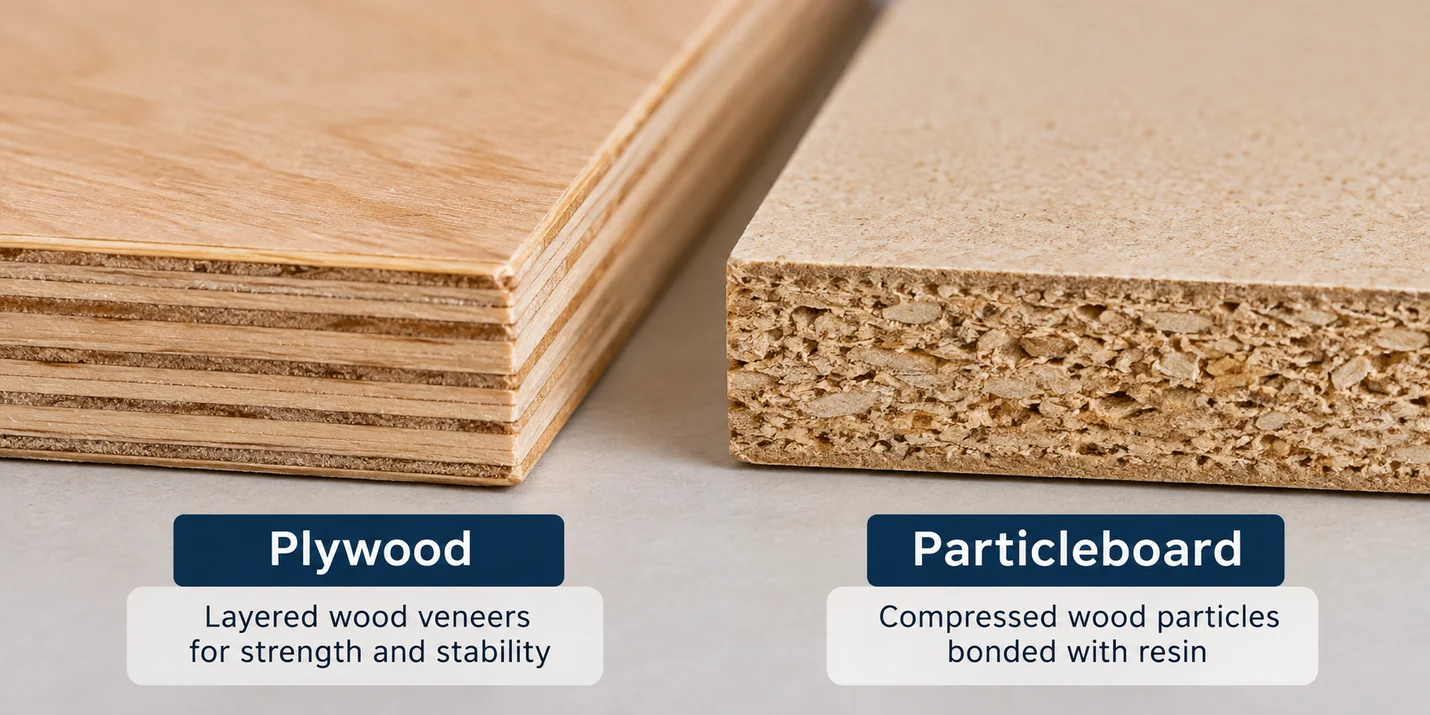
A “plywood cabinet” can still have particleboard shelves, thin backing, or flimsy drawer bottoms. Check the materials and thicknesses of each component, not just the cabinet box.
Half-inch plywood sides and 3/4-inch plywood shelves can be sturdy choices when properly supported. Pay particular attention to the back panel, which plays an important role in secure wall mounting.
Check the back and how wall cabinets hang
The back helps keep a cabinet square. Some wall cabinets fasten through a substantial back panel. Others rely on reinforced hanging rails, and when a properly built rail carries the load, a thin back can be fine. Check the back material and thickness, then look at the mounting system as a whole.
Ask where the mounting screws go and which structural part they pass through. A solid back or a reinforced hanging rail can both work well. A vague answer is a reason to keep asking.
2. Look at how the drawer boxes are built
If you only have time to investigate one detail beyond the cabinet box, make it the drawers.
Drawers experience repeated movement, carry heavy contents, and rely on several components working together. Their construction offers a quick indication of how much attention a manufacturer gives to durability.
Dovetail vs. stapled drawer construction
Dovetail drawers have interlocking corner joints that resist pulling apart, making them a durable choice for wood drawer boxes. You can recognize them by their distinctive pattern. Learn more in our guide to dovetail drawers.
Stapled drawers use simpler joints secured with staples and sometimes glue. Quality varies, but thin particleboard and loose joints are warning signs. Metal-sided drawers can be just as durable as dovetails when they’re paired with quality runners and hardware.
TL;DR: Don’t judge a drawer by its joints alone. Materials, assembly, and hardware all affect how well it holds up.
Metal-sided drawers range from basic runners to engineered box systems from hardware companies such as Blum and Hettich. The material alone doesn’t tell you which one you’re getting. Ask for the maker or model, load rating, extension, and closing system.
Don’t forget the drawer bottom
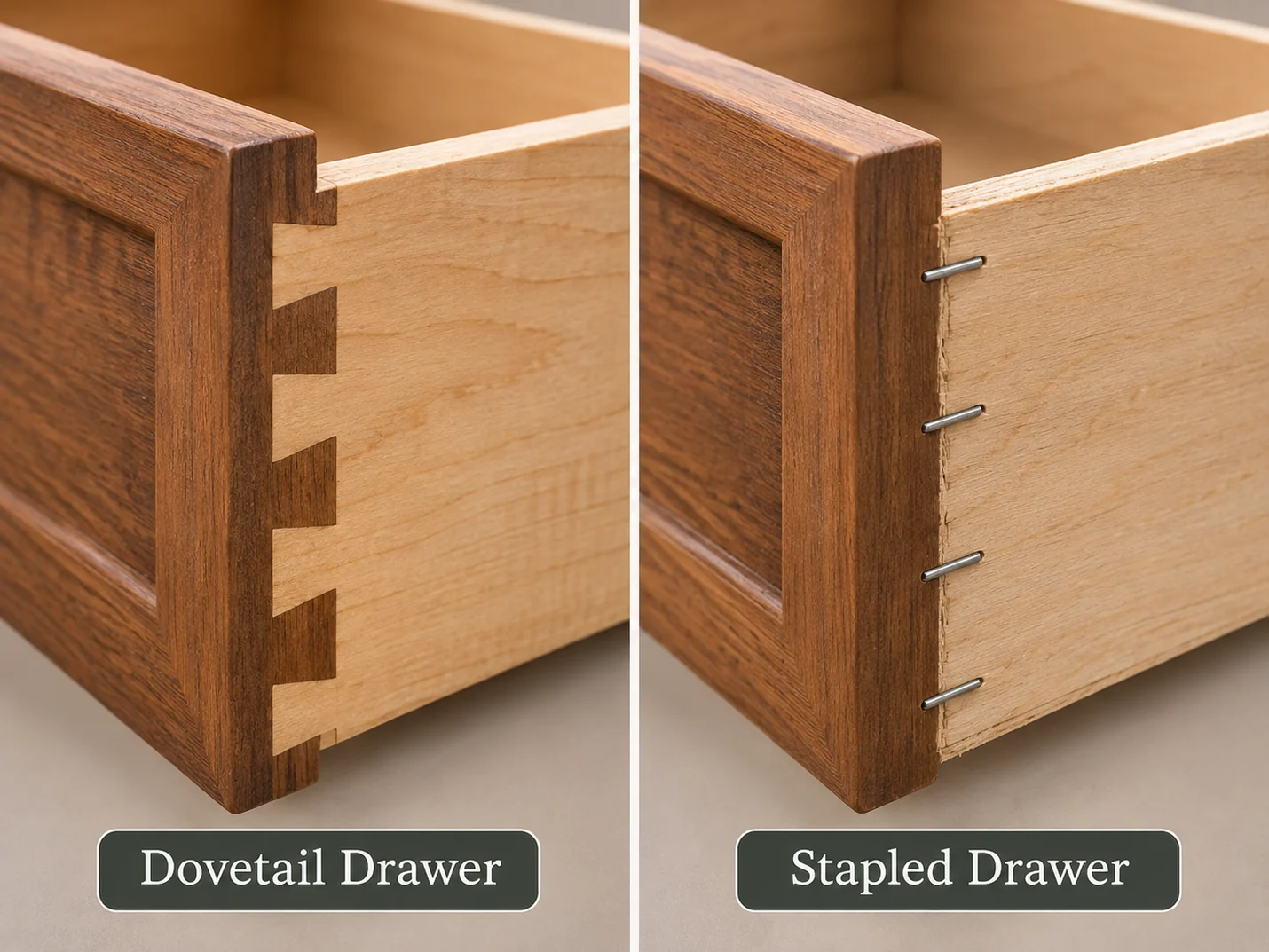
A sturdy drawer box won’t help much if its bottom bends under the weight of cookware.
Look for the drawer bottom’s material, thickness, and installation method. Is it captured in grooves along the drawer sides? Does it have reinforcement for wider drawers? What’s the supported load?
If a seller only advertises “solid wood dovetail drawers,” ask about the bottoms, too.
3. Compare drawer glides and their weight ratings
Drawer glides may be hidden, but you’ll notice their quality every time you open a drawer. The two main types are:
- Undermount glides: Sit beneath the drawer for a cleaner look and often include soft-close features.
- Side-mount glides: Attach to the drawer sides. Quality ball-bearing models can be just as strong and smooth.
Neither type guarantees better quality. Instead, check the weight capacity, extension, and hardware specifications.
Full-extension glides provide easier access to the back of the drawer, while soft-close mechanisms prevent slamming.
Ask about the weight rating
Drawer weight capacity is an important specification that many cabinet listings leave out. Standard residential glides are often rated for 75 to 100 pounds, while heavy-duty models can support more.
Don’t assume soft-close drawers have the same capacity. Ask for the glide manufacturer’s load rating, especially for wide drawers storing heavy cookware or stacks of dishes.
4. Find out whether the hinges are adjustable
Cabinet doors can shift over time, so adjustable hinges are worth looking for. Quality concealed hinges typically offer six-way adjustment, allowing you to move doors up, down, side to side, and in or out without drilling new holes.
Soft-close is a nice bonus, but sturdy construction and adjustability are more important. Learn what to look for in our guide to cabinet hinge types.

Doors can move out of alignment as cabinets settle and hinges loosen with use. A six-way hinge lets you correct a crooked door, uneven gap, or proud edge with a screwdriver. A hinge with less adjustment may need to be loosened, repositioned, or remounted.
5. Understand face frames, frameless construction, and center stiles
Cabinets come in two main construction styles:
- Framed cabinets: Have a solid-wood face frame that reinforces the opening and provides a mounting surface for hinges.
- Frameless cabinets: Have no face frame and rely on the cabinet box for structural support.
A well-built frameless cabinet can be just as durable as a framed one, provided it has quality panels, strong joints, and secure mounting.
Our guide to framed vs. frameless cabinets explains the differences in construction, storage, and installation.
What about I-beams and center stiles?
I-beam construction and other structural bracing help strengthen the cabinet box and support countertops. Check the materials and how the bracing is attached rather than relying on the label alone.
Base cabinets need bracing across the open top to keep the box square and support countertop attachment. A spec sheet may call this I-beam construction, corner blocks, or corner brackets. The label and material don’t prove strength by themselves. Ask what braces the cabinet, how it’s attached, and whether the cabinet line has passed structural testing.
A center stile is the vertical support between cabinet doors. It can reinforce the frame but limits access to larger items. Cabinets without center stiles can be just as sturdy when they’re properly constructed.
6. Don’t confuse full overlay with better construction
Full-overlay doors cover most of the cabinet’s face frame, leaving narrow gaps between doors. Partial-overlay doors expose more of the frame.
Full overlay may look more upscale, but neither style guarantees quality. Instead, check the door construction, hinge adjustment, and consistency of the gaps. Choose the overlay style you like, not the one marketed as better built.

7. Investigate the cabinet finish
Two cabinets can look identical online but show very different wear after years of use. Finish durability depends on how the surface is prepared, coated, and cured.
Catalyzed finishes can offer excellent durability, but other coatings, including waterborne finishes, can perform just as well. Look beyond the finish label and ask about its resistance to scratches, stains, and moisture.
Questions to ask
Ask whether the finish is factory-applied and how it’s tested for resistance to moisture, heat, scratches, and household chemicals. Don’t judge by coat count alone; application and coating quality are more important.
For painted cabinets, inspect edges, joints, and detailed areas for uneven coverage or imperfections that product photos might hide.
Look at how the door is built
A slab door has a flat face and may be made from one material or from a core covered with veneer, laminate, or another finish. A five-piece door, such as a Shaker door, has two rails and two stiles around a center panel.
For stained five-piece doors, ask what the rails, stiles, and center panel are made of. Painted doors often use MDF for the center panel or the entire door because it moves less with changes in humidity. Solid wood moves more, so a fine hairline at a rail-and-stile joint can appear as the seasons change. Our MDF vs. plywood guide explains where each material works well.
8. Be skeptical of “all-wood” and other marketing claims
“All-wood construction” sounds great, but it doesn’t necessarily mean solid hardwood. Cabinets may combine solid wood, plywood, and engineered panels, even when advertised as solid wood.
That’s not always a drawback. Engineered materials can offer better stability, especially in painted cabinet doors.
Instead of relying on marketing labels, ask for a breakdown of the materials used in each component. Both solid wood and furniture-grade plywood can be excellent choices. A seller who can’t explain what’s inside their cabinets is a bigger red flag than engineered wood itself.
Ask about these seven parts: box sides, back, bottom, shelves, drawer sides, drawer bottom, and the door’s center panel. Those answers tell you far more than an “all-wood” label.
9. Check certifications, testing, and warranty terms
Certifications offer more reliable evidence of cabinet quality than marketing claims do. It’s a strong indicator of quality, though uncertified cabinets can still be well built.
The ANSI/KCMA A161.1 standard tests cabinet strength, door and drawer operation, and finish durability.
KCMA certification includes rigorous tests, such as 25,000 door and drawer cycles and a 600-pound wall cabinet loading test.
What about CARB and TSCA Title VI?
CARB Phase 2 and TSCA Title VI address formaldehyde emissions from composite wood products, not cabinet durability. The EPA’s composite wood product standards cover materials such as plywood, MDF, and particleboard.
Compliance is important, but it won’t tell you how well a cabinet is built. Check the warranty, too. Look at what’s covered, exclusions for moisture damage or wear, and whether replacement shipping and labor are included.
How to read a cabinet spec sheet, line by line
Most cabinet websites compress construction into a handful of specification lines. Read each one for what it confirms and what it leaves out. The table below ranks ten common lines by how useful they are when two cabinets look nearly identical online.
| On the spec sheet | What it tells you | How much it tells you | Ask the seller |
|---|---|---|---|
| DrawersSolid wood, dovetail | The drawer-side material and corner joinery. Drawers move and carry weight every day, so material and joint differences show quickly. | The mostStart here | “What are the drawer sides and bottom made of, how are the corners joined, and is the bottom set in a groove?” |
| Box1/2″ plywood | The material and thickness of the cabinet sides. The word “plywood” doesn’t describe the back, bottom, shelves, or top bracing. | A lot | “What are the sides, back, bottom, and top bracing made of, and how thick is each part?” |
| Shelves and back3/4″ plywood shelves, 3/8″ plywood back | Whether the shelves and back use the same material as the box or a different one. It also confirms their thicknesses. | A lot | “What are the shelves and back made of, how thick are they, and how are they supported?” |
| GlidesUndermount, full extension, soft close | Where the glides mount, how far the drawer opens, and how it closes. It says nothing about load capacity. | A lot, if rated | “What’s the load rating, and who makes the glide?” |
| HingesConcealed, 6-way adjustable | How easily the doors can be realigned after installation. | Some | “How do the hinges adjust, and are they soft close?” |
| Frame and bracing3/4″ solid wood face frame, I-beam construction | The construction style and the type of top bracing. The label alone doesn’t confirm how the bracing is attached or tested. | Some | “What braces the top of the cabinet, how is it attached, and has the line passed structural testing?” |
| FinishPremium finish | Often only an adjective. Without the coating, process, or test information, a door sample tells you more. | Some | “Is the finish factory-applied, what’s the topcoat, and how was it tested?” |
| OverlayFull overlay | How much of the face frame shows around the doors. It describes the look. | Little | Nothing. Choose the look you prefer. |
| Wood claimAll-wood construction | Very little on its own. The phrase can include solid wood, plywood, and other wood-based parts. | Little | “What is each cabinet part made of?” |
| TestingKCMA certified, CARB compliant | KCMA certification covers performance testing for a certified line. CARB and TSCA Title VI cover formaldehyde emissions only. | Some | “Which cabinet line is certified or compliant, and where can I verify it?” |
Drawers rank first because they move, carry weight, and make weak materials or joinery easier to spot. Most sellers describe them, too, so this is usually the easiest place to begin a side-by-side comparison.
How to compare cabinet brands using their spec sheets
Once you’ve gathered the specifications, compare competing products side by side. Here’s an example of how two similarly priced cabinet lines might stack up.
| Specification | Cabinet A | Cabinet B |
|---|---|---|
| Box material | 1/2-inch plywood | Unspecified engineered wood |
| Shelves | 3/4-inch plywood | Material not listed |
| Drawers | Dovetail wood boxes | Stapled particleboard |
| Glides | Full-extension, soft-close | Partial-extension |
| Load rating | 100 pounds | Not provided |
| Hinges | Six-way adjustable | Adjustable, details unclear |
| Finish | Factory-applied, tested | Described as premium |
| Certification | Documented KCMA certification | No certification listed |
Illustrative comparison only; these aren’t actual products or Kitchen Cabinet Kings specifications.
Cabinet A has stronger documented construction, while Cabinet B needs a closer look. Missing specifications don’t necessarily mean poor quality, but they’re worth questioning.
Use the same checklist to compare every seller, including us. Don’t give a manufacturer extra credit just for attractive photographs or persuasive product descriptions.
What to check when your cabinet samples arrive
Specifications tell you how cabinets are built, but samples let you judge the finish firsthand. Before buying, order cabinet door samples to examine them in your own lighting.
Check edges and corners for consistent coverage, feel for rough spots, and inspect both sides. Look for uneven paint or stain.
A door sample won’t reveal the quality of the cabinet box or hardware, but it can expose finish flaws that product photos are more likely to hide.
A full-size door shows the profile, edge treatment, front, and back. On a five-piece door, it also lets you inspect the joints. A color chip shows the color.
Order two or three doors and place them side by side in your kitchen. Differences in color, sheen, edge detail, and finish are easier to see when the samples are next to one another.
Buy cabinets based on construction, not claims
A cabinet’s appearance tells you very little about how it will hold up after years of daily use.
You need to know what’s behind the doors: the box materials, drawer joints, hardware, finish, and testing.
A good seller should make those details easy to find and be willing to answer questions when information is missing.
Take this to any cabinet website (ours too)
- The material and thickness are listed for the box sides, back, and bottom.
- The shelf material, thickness, and support are listed.
- The drawer-side material, joinery, and bottom construction are listed. If it’s a metal system, the maker or model is named.
- The glides list their extension, closing action, and load rating.
- The hinge adjustment and closing action are stated.
- The finish process or durability testing is explained.
- Any certification identifies the cabinet line it covers.
- The warranty says what it excludes.
- You can order a full-size door sample before you buy.
Every unchecked line becomes a question to ask before you order. A low price is harder to compare when the construction details are missing. Our guide to the hidden costs of cheap cabinets explains what those omissions can cost later.
Use this checklist when you shop kitchen cabinets, whether you’re comparing our products with another seller or choosing between different cabinet lines.
Once you’ve narrowed down the construction specifications, order a door sample to check the finish and material in person. Between the paperwork and the physical sample, you’ll have a much better understanding of what you’re paying for.
Common questions about cabinet quality
How can you tell if kitchen cabinets are high quality?
Start with the box material, drawer construction, glides, hinges, and finish. Look for clearly documented specifications, proven hardware, sturdy joinery, and independent performance testing where available. A seller should be able to explain what each cabinet component is made from.
Are plywood cabinets better than particleboard cabinets?
Plywood generally offers better screw-holding strength and moisture tolerance, but quality depends on panel thickness, joinery, and overall construction. Well-engineered particleboard cabinets can still perform well in appropriate applications.
Are dovetail drawers always better?
Dovetail joints are strong and durable, particularly in traditional wood drawer boxes. However, properly engineered metal-sided systems and other well-constructed drawer designs can perform just as well or better for certain applications.
Are expensive cabinets always better quality?
No. Higher prices may reflect customization, finishes, brand positioning, or manufacturing costs rather than superior construction. Comparing the actual specifications is more reliable than comparing prices alone.
What is the most important cabinet quality feature?
The cabinet box and drawer system are especially important because they handle structural loads and everyday use. Focus on sound construction and appropriately rated hardware rather than relying on any single feature.
Are RTA cabinets good quality?
They can be. RTA describes how a cabinet ships. Some manufacturers sell the same cabinet line flat-packed or assembled, with the same box, drawers, and hardware. Compare the construction specifications, then follow the assembly instructions and square each cabinet before installation. Our RTA vs. assembled cabinets guide compares the two options.
How long do kitchen cabinets last?
About 50 years under normal conditions, according to InterNACHI‘s general estimate for kitchen cabinets. Construction, installation, daily use, and water exposure all affect how long a cabinet lasts. Hinges and glides can often be replaced, while water damage to the box is harder to repair.
Will my cabinets match the door sample?
Yes, if the sample is a current one from the same cabinet line and finish. Expect small differences: stained wood varies naturally in grain and tone, painted finishes can shift slightly between production runs, and every color looks different as the light changes. The sample is still the best way to judge the door before you order.
Sources
- Kitchen Cabinet Manufacturers Association, “Cabinets Certified to Last.” ANSI/KCMA A161.1 test requirements. kcma.org (opens in a new tab)
- Kitchen Cabinet Manufacturers Association, “KCMA Quality Cabinet Certification.” kcma.org (opens in a new tab)
- U.S. Environmental Protection Agency, “Formaldehyde Emission Standards for Composite Wood Products.” www.epa.gov (opens in a new tab)
- InterNACHI, “Standard Estimated Life Expectancy Chart for Homes.” www.nachi.org (opens in a new tab)

Andrew Saladino
Andrew Saladino co-founded Kitchen Cabinet Kings in 2010, and the company has since delivered cabinets for more than 110,000 kitchens. Named to the NKBA 30 Under 30 in 2013 and 2014, he writes about cabinet styles, construction, finishes, costs, lead times, and the ordering details that are easy to miss until the cabinets arrive.