

Upper Cabinet Depth: How to Choose Between 12, 15, and 18 Inches

by Andrew Saladino
October 29, 2026
Three extra inches of cabinet storage sounds like an easy decision. Who wouldn’t want more room for dishes, glassware and all those serving platters that somehow manage to multiply every holiday season?
But deeper upper cabinets come with a tradeoff: they extend farther over your countertop, putting more storage within reach while potentially making your workspace feel cramped. Go too deep, and you might find yourself ducking under cabinet doors or struggling to see what you’re chopping.
The standard upper cabinet depth is 12 inches. And while 15- and 18-inch options can work beautifully in the right kitchen, more storage isn’t automatically better.
Here’s how to decide whether to stick with the standard or go deeper.
The Short Answer The standard upper cabinet depth is 12 inches, half the depth of a 24-inch base cabinet, and it’s the best fit over counters where you prep or clean. Every extra inch projects farther over the counter. Use 15- or 18-inch uppers where you don’t work underneath, such as a wall with no base cabinets or one section reserved for large platters. Over the refrigerator, 24 inches is standard because a 12-inch cabinet is hard to reach.
Why Are Upper Cabinets Usually 12 Inches Deep?
Most kitchen upper cabinets are 12 inches deep, compared to the standard 24-inch depth of base cabinets. This difference leaves approximately half the countertop depth unobstructed by overhead cabinetry.
When you’re standing at the counter, that extra space gives you room to lean forward, look down at your work and move without constantly worrying about bumping your head. A standard 12-inch cabinet also accommodates everyday kitchen essentials, including drinking glasses, dinner plates, mugs and smaller pantry items.
Twelve inches strikes a practical balance between storage and workspace, though some kitchens can accommodate deeper cabinets. Our guide to standard kitchen cabinet sizes covers the full range of dimensions, but the real question is where those extra inches will help, and where they’ll get in the way.
12 vs. 15 vs. 18 Inch Upper Cabinets: What Changes?
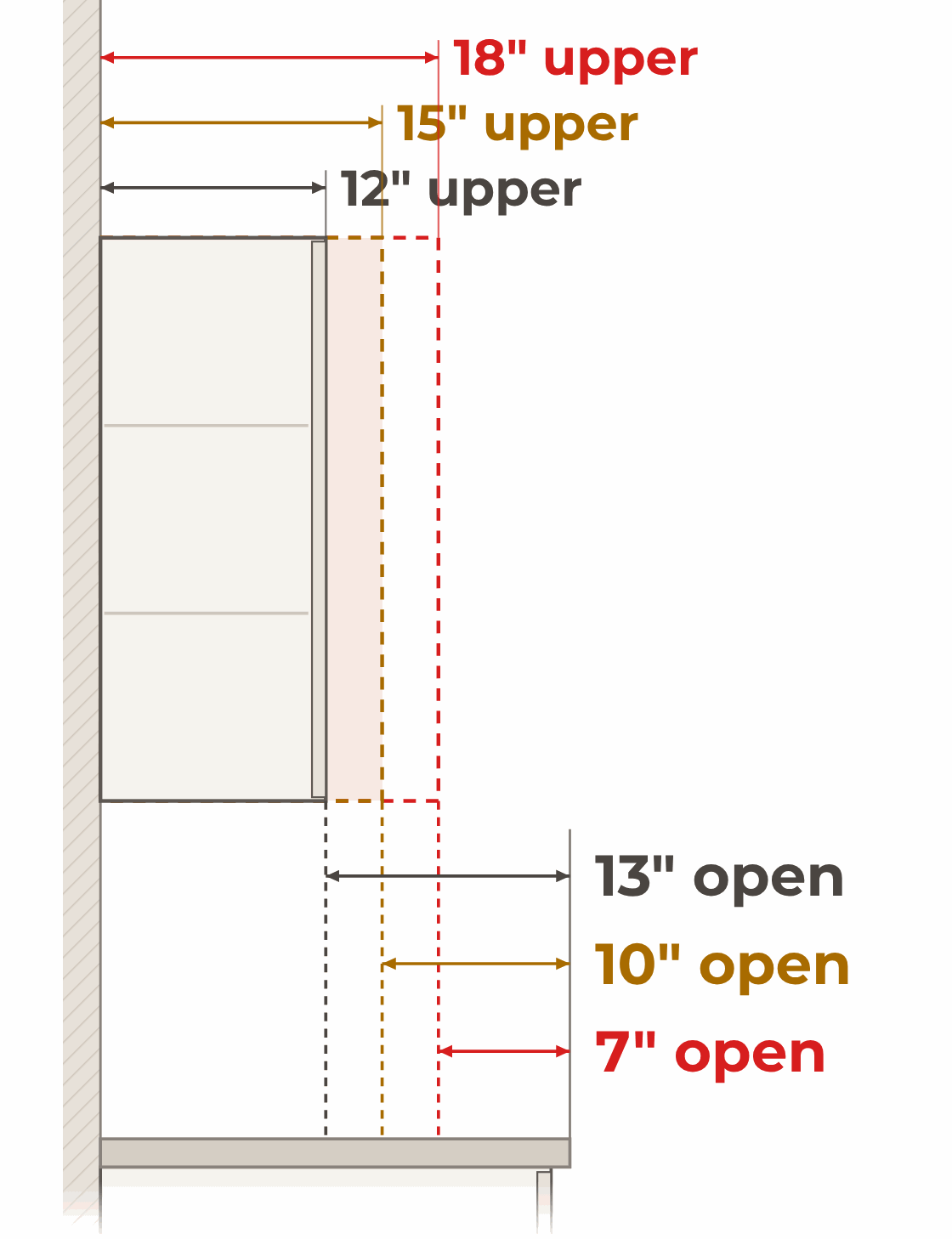
In addition to storage space, increasing the upper cabinet depth from 12 to 15 or 18 inches changes how the cabinets interact with the countertops, how easily you reach into them and even how large the kitchen feels.
12-Inch Upper Cabinets: The Everyday Standard
For most kitchens, 12-inch uppers provide sufficient storage without interfering with countertop activities. They work particularly well above food preparation areas, in compact kitchens and anywhere you’re frequently leaning over the counter.
They’re also widely available across cabinet collections, making them an economical choice with relatively predictable ordering and installation.
The downside? Oversized dinnerware, serving platters and bulky appliances may not fit comfortably.
15-Inch Deep Upper Cabinets: A Little More Breathing Room for Your Dishes
At 15 inches deep, you gain three additional inches of storage depth. That may not sound like much, but it can make a noticeable difference when storing larger plates, serving bowls or containers that don’t fit inside standard wall cabinets.
The tradeoff is less open space above the countertop, which can make the work area feel cramped. Still, 15-inch uppers offer a practical compromise between extra storage and comfortable workspace.
18-Inch Deep Upper Cabinets: Maximum Storage, Bigger Compromises
An 18-inch upper extends six inches farther than a standard cabinet, providing more room for bulky items but making the back harder to reach. It can also obstruct your view of the countertop, limit workspace comfort, and make the kitchen feel crowded.
For these reasons, 18-inch uppers generally work better in select areas than they do throughout the kitchen.
How Deeper Upper Cabinets Affect Your Kitchen
Start with the dimensions. A standard countertop is about 25 inches deep, and upper cabinets usually hang 18 inches above it. Every inch added to cabinet depth reduces the open counter in front by the same amount.
| Upper cabinet depth | Open counter in front of it |
|---|---|
| 12-inch upper | 13 inches |
| 15-inch upper | 10 inches |
| 18-inch upper | 7 inches |
How it feels: Put a 10-inch cutting board at the front edge of the counter. Under a 12-inch upper, you’ve got 3 inches of open counter behind it. Under a 15-inch upper, the back of the board lines up with the cabinet. Under an 18-inch upper, the back 3 inches sit beneath the cabinet.
Deeper uppers block more ceiling light, leaving the back of the counter in shadow. Plan on under-cabinet lighting if you go deeper.
Before choosing deeper cabinetry, consider these three everyday consequences that aren’t always obvious on a floor plan.
Less Comfortable Countertop Space
Deeper uppers don’t reduce your countertop space, but they can make it harder to use. An 18-inch cabinet extends farther over your work area, potentially forcing you to move cutting boards and other items toward the counter’s front edge to avoid bumping your head or obstructing your view.
More Difficult Reach
Deeper cabinets offer more storage, but items at the back can be difficult to reach, especially on higher shelves. This is particularly important for shorter homeowners. If you’re under 5’4″, test your reach before choosing deeper uppers to make sure the extra storage will actually be accessible.
A More Enclosed Appearance
Deeper uppers can make a kitchen feel crowded, especially in narrow galley layouts where cabinets line both walls. While the extra depth may go unnoticed in a spacious kitchen with high ceilings, it can make smaller spaces feel cramped.
When Are Deeper Upper Cabinets Worth It?
Despite those compromises, deeper cabinetry can be an excellent choice when the kitchen’s layout and storage needs justify it. Consider 15- or 18-inch deep upper cabinets in these situations:
- Tall ceilings: A spacious kitchen with generous ceiling height can sometimes accommodate deeper cabinets without making the room feel crowded.
- Walls without base cabinets: A larger wall cabinet depth may work well where there isn’t a countertop workspace directly below them.
- Pantry walls: Cabinets used primarily for food storage can benefit from additional depth, particularly when coordinated with full-height pantry cabinetry.
- Oversized dinnerware: Large platters, serving bowls and specialty dishes may justify deeper storage in one designated location.
Pro Tip
If tall ceilings are the reason you’re considering deeper cabinets, look up first. With ceilings 9 feet or higher, 42-inch uppers or a second row of short cabinets can add storage without projecting farther over the counter.
Mixing cabinet depths can make better use of your space. For example, you might choose standard wall cabinets above prep areas and deeper options near the pantry. You can browse our cabinet gallery for inspiration on combining different configurations.
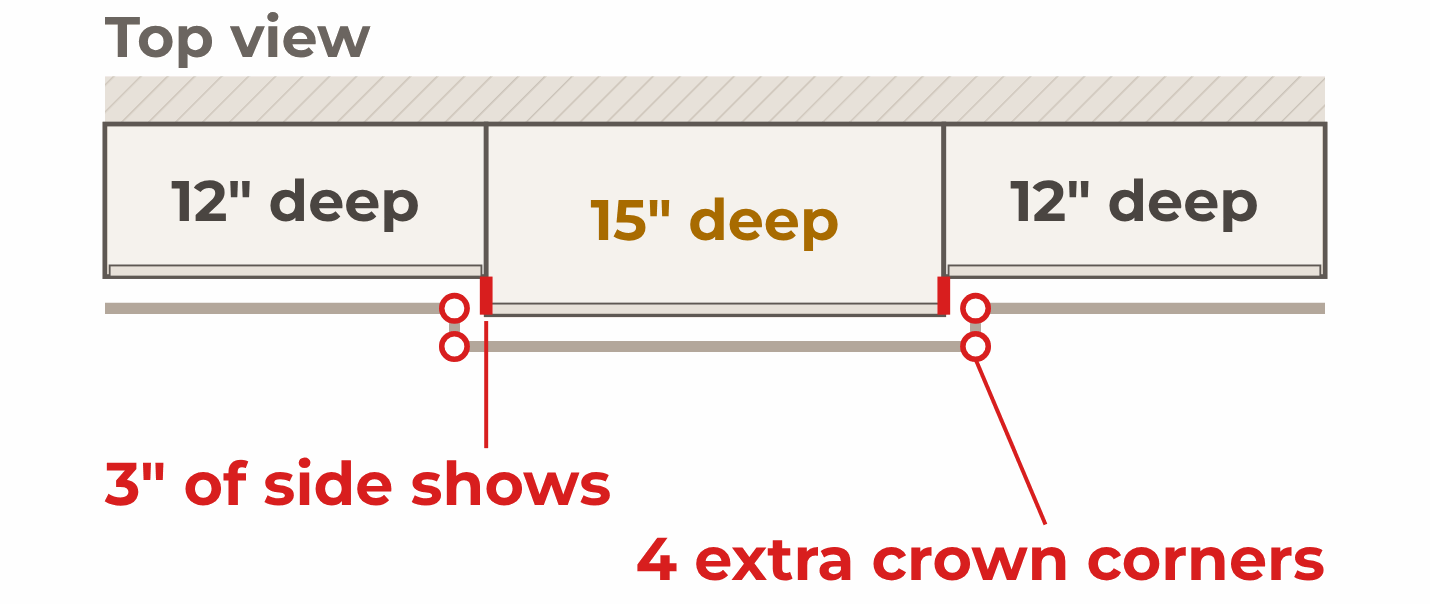
Mixing depths creates one detail you need to plan around. A 15-inch cabinet beside 12-inch uppers projects 3 inches farther, exposing 3 inches of its side. That side needs a matching finished panel, and the crown molding has to turn around the step. Our designers account for those panels and molding pieces in every free design before the order ships.
What About 24-Inch Uppers on a Whole Wall?
Above a counter where you work, skip them. A 24-inch upper lines up with the base cabinet below, leaving only about an inch of counter you can lean over.
On a wall without a counter, tall pantry cabinets usually make better use of the space. They come 12 or 24 inches deep and start at the floor, putting more of the storage within reach. Our deep wall cabinets are sized for refrigerators. A full-height, deep upper elsewhere requires an assembled cabinet with a depth modification.
Where Should You Avoid Deeper Upper Cabinets?
Deeper uppers can make narrow galley kitchens feel cramped and interfere with movement above busy prep areas.
Again, they’re also less practical for shorter homeowners or those with limited mobility. In these cases, drawers, better pantry organization or tall cabinets may provide more accessible storage without sacrificing comfort.
The Exception: Upper Cabinet Depth Over the Fridge
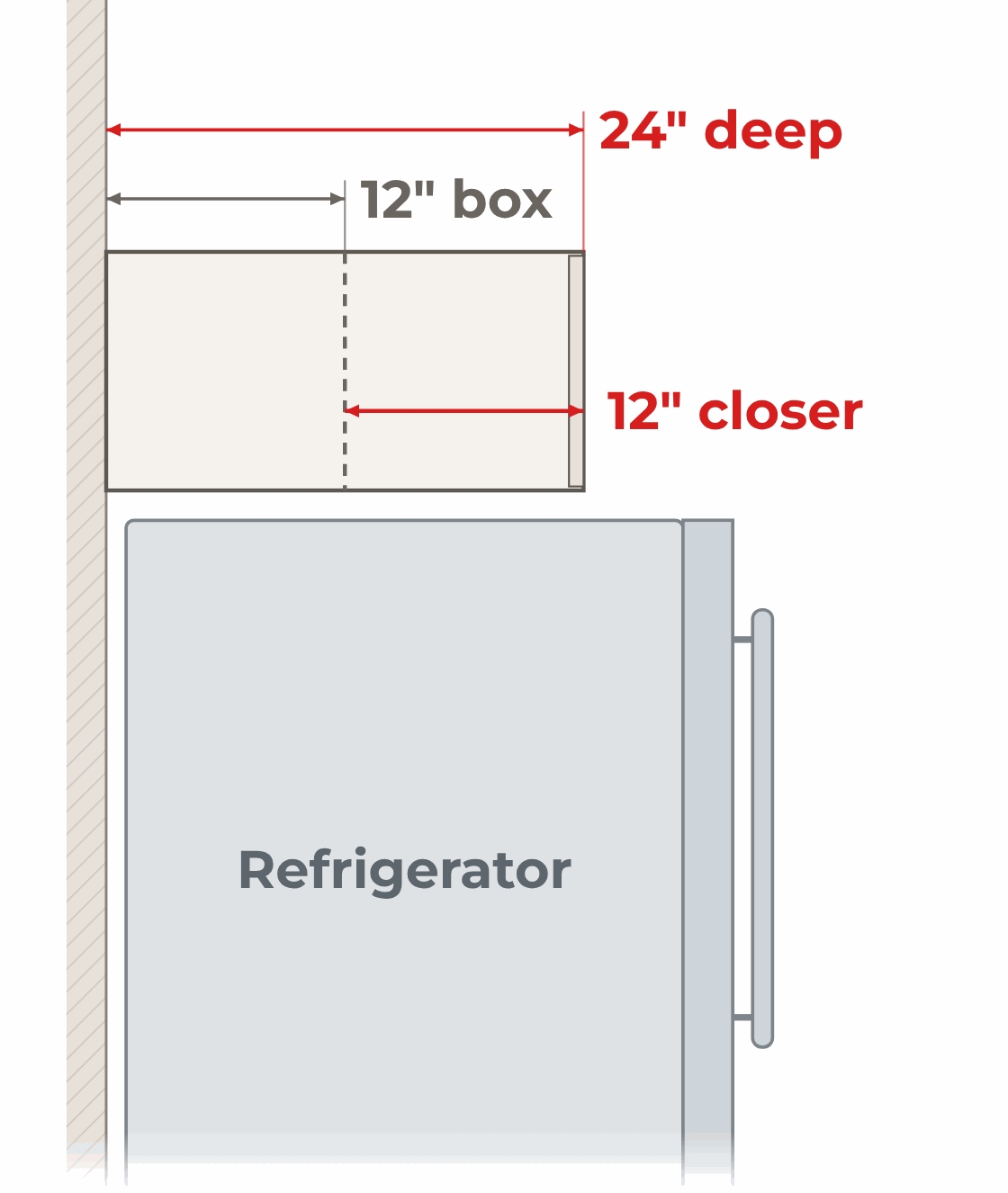
If you’ve been researching upper cabinet depth over fridge installations, you’ve probably encountered 24-inch deep upper cabinets.
Yes, they’re considerably deeper than standard wall cabinets, and there’s a practical reason why.
Refrigerators often extend much farther into the room than surrounding base cabinets. A shallow 12-inch cabinet above a refrigerator can be difficult to access because you have to reach across the appliance to retrieve anything.
A 24-inch deep refrigerator cabinet brings storage closer to the front of the refrigerator, improving access and creating a more integrated appearance.
These cabinets are commonly used for occasional storage, such as holiday serving pieces or rarely used appliances. However, refrigerator dimensions vary. Consider the appliance’s actual depth, door swing, ventilation requirements and surrounding clearances before you choose your cabinetry.
Once the cabinet is installed, see our ideas for the space above your refrigerator.
What About Cabinets Above Sinks and Ranges?
Cabinets above sinks and ranges require additional clearance considerations. Deeper uppers above a sink can obstruct your view or make washing dishes uncomfortable, while cabinets above a range must meet appliance-specific safety requirements.
Avoid deep uppers above the sink. You lean farther over a sink than any other part of the counter, so a deep cabinet is more likely to block your view or get in the way. That’s why many sink walls use a window or a shorter cabinet instead.
For example, Whirlpool notes that some cooking appliances require 30 inches of clearance from combustible cabinetry. Certain GE over-the-range microwaves also specify cabinet depths of 12 to 13 inches.
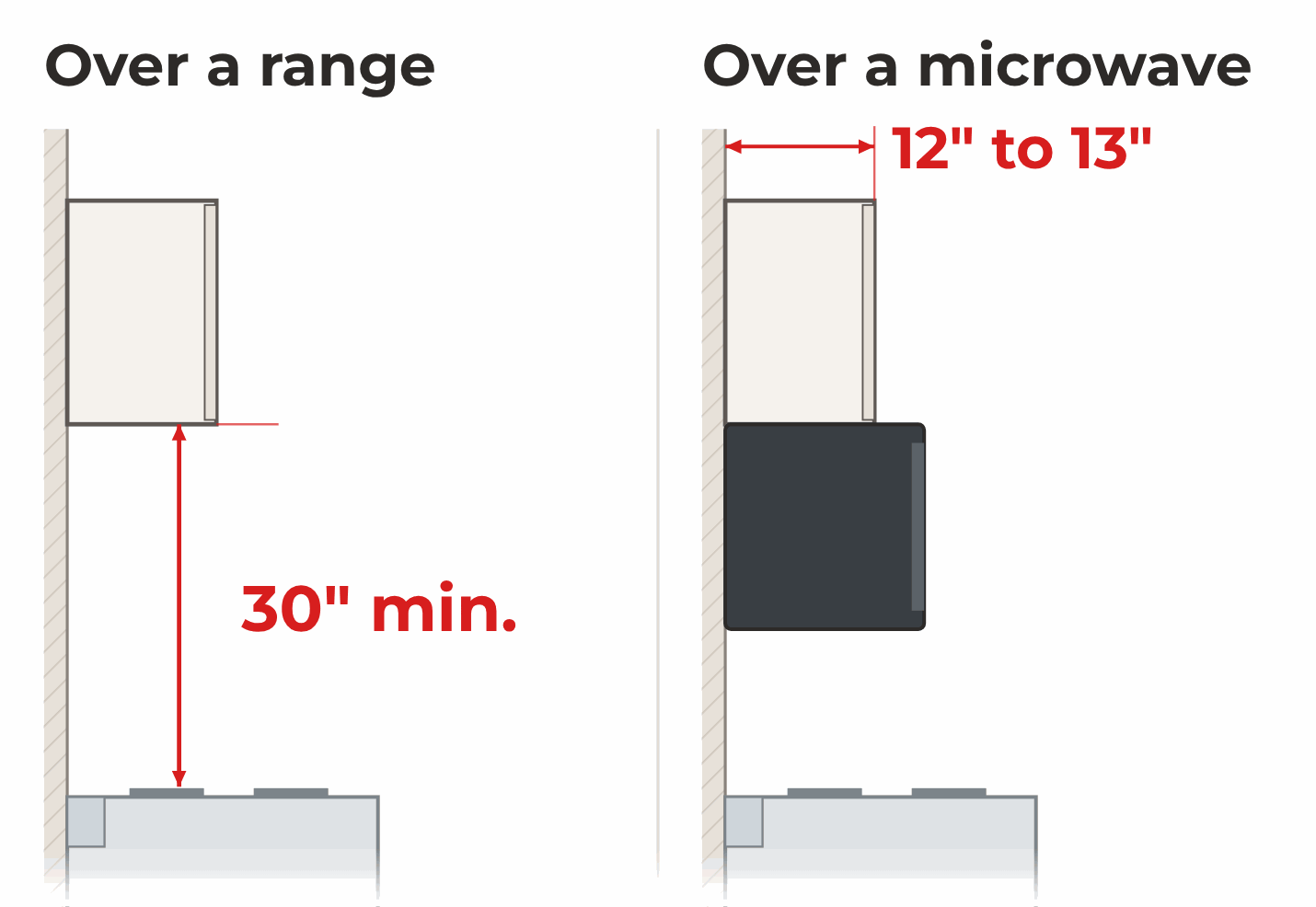
If you’re installing a hood, its installation guide determines the mounting height and the cabinet dimensions around it.
Always check your appliance’s installation instructions and local building codes before choosing cabinet depth.
Do Deeper Upper Cabinets Cost More?
Deeper upper cabinets may cost more, depending on the manufacturer and available sizes.
While 12-inch cabinets are widely stocked, 15- and 18-inch options may require special orders, limiting finish choices and increasing lead times. Compare pricing and availability before committing, especially since extra storage isn’t worth much if you can’t comfortably reach it.
For our cabinet lines, the choice starts with RTA or assembled.
| RTA | Assembled | |
|---|---|---|
| Wall cabinet depth | 12 inches | 12 inches |
| 15 or 18 inches | Not offered | Depth modification on many lines |
| Ships in | 3 to 10 business days | 5 to 15 business days |
Both formats include deep cabinets for above the refrigerator in most lines. For a 15- or 18-inch cabinet elsewhere, choose assembled and add a depth modification. The modification carries a flat per-cabinet fee, close to half the price of a standard 30-inch wall cabinet. Because the fee is the same regardless of cabinet width, it has a larger effect on smaller cabinets. Keeping extra depth to one zone can control the added cost.
The modification doesn’t add shipping time. It ships with the rest of your assembled order in 5 to 15 business days. Browse our assembled kitchen cabinets page to see the available styles.
How to Choose the Right Upper Cabinet Depth
Before ordering, consider where you use your countertops most, whether your larger dishes actually require deeper storage, and who needs to reach the cabinets. Our guide on how to measure your kitchen for cabinets can help you plan. You can also use cardboard or painter’s tape to mark the proposed depth and test how comfortably you can work beneath it.
| Location | Upper cabinet depth |
|---|---|
| Over prep counters | 12 inches |
| Over the sink | 12 inches, or a shorter cabinet |
| Over the range | Whatever the hood or microwave guide allows |
| Over the fridge | 24 inches |
| Wall with no counter | 15 to 24 inches, or tall pantry cabinets |
| Galley kitchen | 12 inches, or 9 if it feels tight |
Frequently Asked Questions
How deep are upper cabinets normally?
Standard upper kitchen cabinets are usually 12 inches deep. This provides everyday storage while maintaining comfortable access to the countertop below.
Are all upper cabinets 12 inches deep?
No. While 12 inches is standard, 15-inch deep upper cabinets and deeper specialty options are available. Some refrigerator cabinets are 24 inches deep, while custom cabinetry can accommodate other dimensions.
What depth do wall cabinets come in?
Standard wall cabinets are 12 inches deep, while cabinets made for above the refrigerator are usually 24 inches deep. Many assembled cabinet lines can be modified to 15, 18, or 21 inches, or made shallower for tight spaces.
Are there 15-inch deep wall cabinets?
Yes. In most cabinet lines, a 15-inch wall cabinet starts as a standard cabinet with a depth modification rather than a stock size. We offer 15-inch depth modifications on many assembled lines. Our RTA wall cabinets are 12 inches deep.
Can upper cabinets be 18 inches deep?
Yes. Upper cabinets can be 18 inches deep, although availability depends on the manufacturer. They’re most useful where additional storage is needed, and the extra projection won’t interfere with countertop activities or comfortable reach.
Are 15-inch upper cabinets too deep?
Not necessarily. A 15-inch cabinet provides three additional inches of depth compared with the standard size. It can work well in larger kitchens or selected storage areas, but may feel intrusive above busy work surfaces.
Are all cabinets 24 inches deep?
No. Base cabinets are usually 24 inches deep, standard upper cabinets are 12 inches, and over-the-refrigerator cabinets are often 24 inches. Tall pantry cabinets come in depths of 12 and 24 inches. See our standard kitchen cabinet sizes guide for the full chart.
Should upper cabinets be the same depth throughout the kitchen?
No. Using different cabinet depths can improve functionality. For example, 12-inch uppers may be appropriate above prep counters, while a deeper cabinet works better near a pantry or above the refrigerator.
How deep should the cabinet over a microwave be?
Many over-the-range microwave models call for a 12 to 13-inch-deep cabinet above because the microwave mounts to it. Check your model’s installation guide before ordering a deeper cabinet for that location.
Should deeper upper cabinets hang higher?
Hanging deeper cabinets higher creates more room over the counter, but it also makes every shelf harder to reach. The top shelf moves up, and the back of a deeper shelf is already farther away. Mark both heights with painter’s tape and test your reach before deciding.
Can upper cabinets be less than 12 inches deep?
Yes. A 9-inch upper can make a narrow galley feel more open, and many assembled lines offer that depth as a modification. Standard dinner plates, usually 10 1/2 to 11 inches across, won’t fit flat in a cabinet that shallow, so plan another place for them.
See How Different Cabinet Depths Work in Your Kitchen
Upper cabinet depth is one of those decisions that looks perfectly inconsequential on a cabinet list but can feel completely different from what you might expect once everything is installed.
Before you commit to 15- or 18-inch uppers, see how they’ll interact with your countertops, appliances and available space.
Kitchen Cabinet Kings offers a free 3D kitchen design to help you visualize your layout, compare cabinet options and make informed decisions before ordering.
After all, a few extra inches of storage shouldn’t leave you wishing you had a little more room to move.

Andrew Saladino
Andrew Saladino co-founded Kitchen Cabinet Kings in 2010, and the company has since delivered cabinets for more than 110,000 kitchens. Named to the NKBA 30 Under 30 in 2013 and 2014, he writes about cabinet styles, construction, finishes, costs, lead times, and the ordering details that are easy to miss until the cabinets arrive.